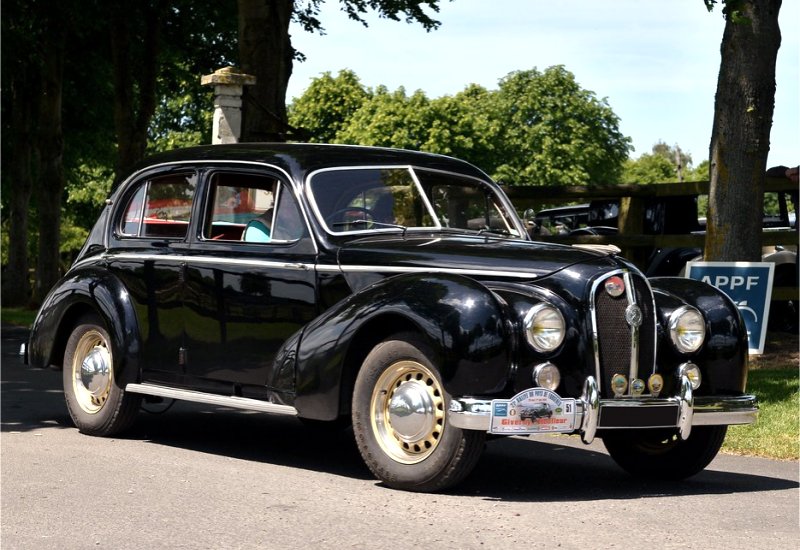
Hotchkiss Anjou 13.50
The Hotchkiss Anjou 13.50 was one of the most elegant and dignified French automobiles of the early 1950s, representing the final chapter in Hotchkiss’s long tradition of luxury touring cars. Introduced in 1950, the Anjou was a refined evolution of the prewar 686 series—modernized in styling but still rooted in the solid engineering and understated sophistication that had long defined the marque. The designation “13.50” referred to its French fiscal horsepower rating, which placed it in the upper-middle range of luxury automobiles, offering both performance and comfort for the discerning postwar motorist.
The Anjou was built around the proven 3.5-litre inline six-cylinder engine that had powered the earlier 686 and 686 S49 models. This overhead-valve unit produced around 125 horsepower and was paired with a four-speed manual gearbox, providing smooth and flexible performance. The engine was renowned for its refinement and reliability, delivering effortless power at low revs and allowing the car to cruise comfortably at speeds of up to 145 km/h (90 mph). It maintained the mechanical character that had made Hotchkiss cars famous—quiet, unhurried, and durable.
The chassis was equally well engineered, featuring independent front suspension with coil springs and a live rear axle supported by semi-elliptic leaf springs. Hydraulic brakes provided confident and progressive stopping power, while the steering—precise and well weighted—gave the car a composed and predictable feel on the road. Though not designed for outright sportiness, the Anjou offered exceptional stability and comfort, qualities that made it an ideal grand touring car for long journeys across postwar Europe.
Stylistically, the Hotchkiss Anjou reflected the restrained elegance of its lineage, with a touch of modern flair suited to the early 1950s. The body was designed by the in-house team under the direction of Jean Daninos—who would later gain fame as the founder of Facel Vega—and it represented one of the most refined French automotive designs of its time. The car featured smooth, flowing lines with gently rounded fenders integrated into the body, a broad vertical grille adorned with the Hotchkiss badge, and subtle chrome trim that emphasized its length and grace. The overall appearance was dignified rather than flamboyant, exuding quiet confidence and impeccable taste.
The Anjou 13.50 was offered in two main body styles: a four-door sedan (berline) and a two-door coupé, both hand-built with meticulous craftsmanship. The sedan, in particular, stood out for its superb proportions, slightly sloping rear roofline, and well-balanced stance. The fit and finish were exemplary, reflecting Hotchkiss’s tradition of precision workmanship carried over from its engineering roots in both automobile and armament manufacturing.
Inside, the Anjou 13.50 offered a level of luxury and attention to detail that rivaled the finest European marques. The cabin was trimmed in rich materials—leather upholstery, polished wood veneers, and finely crafted metal fittings. The dashboard was clean and symmetrical, with elegantly framed instruments and solid mechanical switches that gave a sense of enduring quality. Comfort was paramount: the seating was generous and deeply cushioned, and sound insulation ensured a quiet and serene driving experience. Every detail was designed to convey refinement, from the smooth action of the door handles to the precise click of the gear lever.
On the road, the Anjou 13.50 demonstrated the best qualities of Hotchkiss engineering. The six-cylinder engine provided ample torque, allowing for smooth, effortless acceleration even at low speeds. The car’s composure at speed was remarkable, gliding over long distances with a sense of calm authority. The suspension absorbed imperfections gracefully, while the hydraulic brakes provided steady, reliable deceleration. It was a car for drivers who valued precision and quiet power rather than flamboyant performance—a true voiture de grande classe.
The Hotchkiss Anjou was named after the French region of Anjou, evoking images of refinement and tradition. It was also one of the last models to carry the Hotchkiss badge before the company merged with Delahaye in 1954 and gradually ceased automobile production. Though it shared mechanical components with the later Hotchkiss-Grégoire—a technically advanced but less successful model—the Anjou remained a classically engineered car, true to the company’s legacy of craftsmanship and dependability.
Today, the Hotchkiss Anjou 13.50 is regarded as one of the most elegant postwar French luxury cars. It stands as a symbol of continuity between the refined prewar grand tourers and the modern designs of the 1950s. Collectors admire it for its mechanical integrity, smooth performance, and timeless style. The Anjou was not a car for ostentation but for connoisseurs—those who appreciated engineering excellence wrapped in quiet sophistication. It remains a fitting tribute to one of France’s most respected and enduring marques, marking the graceful finale of the Hotchkiss automobile legacy.
