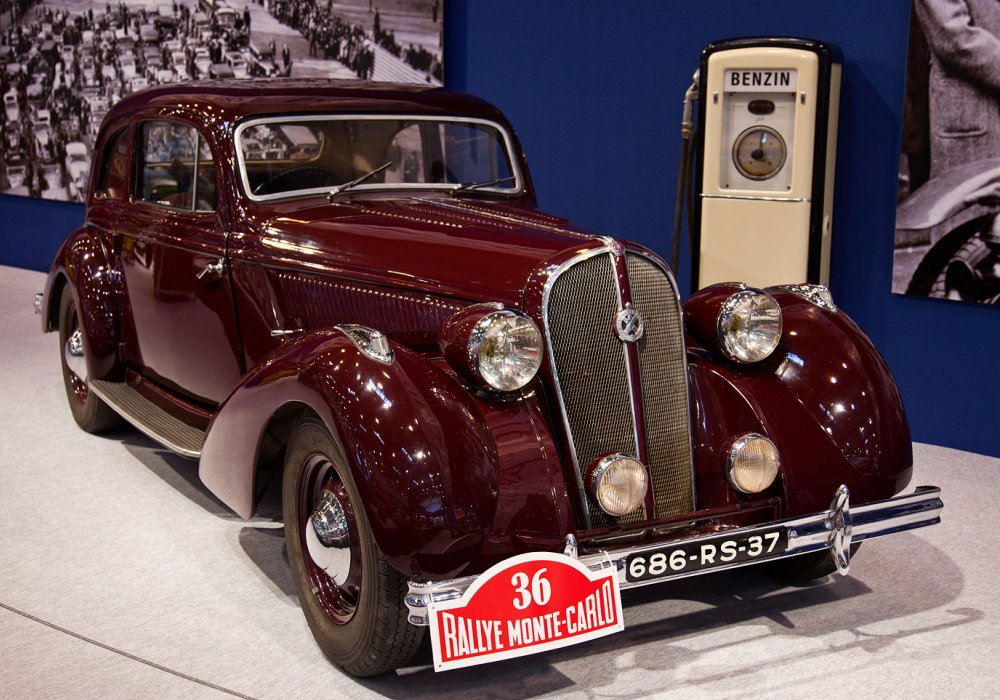
Hotchkiss 686 Grand Sport Coupé
The Hotchkiss 686 Grand Sport Coupé was one of the most distinguished and beautifully engineered French automobiles of the late 1930s, representing the pinnacle of the marque’s blend of mechanical excellence, refined style, and discreet luxury. A high-performance variant of the 686 range introduced in 1936, the Grand Sport Coupé combined the robust engineering for which Hotchkiss was celebrated with the grace and individuality of custom French coachbuilding, creating a car that was as much a work of art as it was a machine.
At the heart of the 686 Grand Sport Coupé was its exceptional 3.5-litre inline six-cylinder engine. Equipped with an overhead-valve configuration and precision-built components, it produced approximately 120 horsepower—ample power for a grand touring car of the period. The engine was smooth, flexible, and remarkably quiet, capable of propelling the car to around 145 km/h (90 mph). Power delivery was effortless, with abundant low-end torque that made it equally suited to city driving or long-distance touring. Reliability was a cornerstone of the Hotchkiss name, and the Grand Sport engine, in particular, was known for its endurance and mechanical refinement.
The chassis was built to the company’s exacting standards, combining strength and balance in equal measure. The 686 Grand Sport featured a steel ladder-type frame, independent front suspension with coil springs, and a live rear axle with semi-elliptic leaf springs, providing a smooth yet controlled ride. The car’s road manners were exemplary—stable, precise, and confidence-inspiring even on poor roads. Four-wheel hydraulic brakes ensured secure and progressive stopping, and the four-speed manual gearbox shifted with the crisp precision that Hotchkiss owners had come to expect.
The design of the Grand Sport Coupé captured the essence of French automotive elegance. With its long, flowing bonnet, upright chrome grille bearing the winged Hotchkiss badge, and gracefully contoured fenders, the car projected both power and sophistication. The coupé body style—typically bodied by the finest French coachbuilders such as Henri Chapron, Vanvooren, or Letourneur et Marchand—was the perfect expression of the model’s character. These bespoke ateliers produced hand-shaped steel and aluminum bodies, each tailored to the owner’s desires. Some featured two-seat configurations with flowing rooflines and rear spats over the wheels, while others adopted a 2+2 layout with an elegant fastback silhouette.
Chapron’s interpretation of the Grand Sport Coupé is especially admired for its proportion and purity of line. His designs favored a restrained elegance, avoiding ornamentation in favor of harmonious form. The result was a car that appeared modern yet timeless, perfectly balanced between sporting intent and luxury. Subtle details—such as gently flared wings, neatly integrated headlights, and a tapering rear deck—gave the car a sense of motion even at rest.
Inside, the 686 Grand Sport Coupé offered the refinement and comfort expected from a top-tier French automobile. The cabin was upholstered in fine leather, with beautifully crafted wooden trim adorning the dashboard and door panels. The instrumentation was clear and functional, with finely machined knobs and switches that reflected the mechanical precision of the car’s construction. Seating was generous and supportive, and the driving position offered excellent visibility through the car’s elegant curved glass. It was a cabin built for long journeys—a space of quiet luxury where craftsmanship and comfort coexisted seamlessly.
On the road, the Grand Sport Coupé lived up to its name. The car’s six-cylinder engine delivered smooth, confident acceleration, while the supple suspension absorbed imperfections with ease. The steering was direct and communicative, and the car’s overall balance made it particularly enjoyable to drive on winding country roads. Although designed for effortless touring rather than outright speed, the 686 Grand Sport could maintain high cruising speeds all day long, its composure and refinement making it one of the most accomplished voitures de grand tourisme of its generation.
Production numbers were limited, as each 686 Grand Sport was hand-assembled and bodied to individual order. This exclusivity, combined with the model’s high cost, meant that it appealed primarily to a wealthy and discerning clientele—industrialists, professionals, and aristocrats who desired performance without ostentation. The outbreak of the Second World War in 1939 brought production to an end, marking the 686 Grand Sport Coupé as one of the last great expressions of prewar French motoring elegance.
Today, the Hotchkiss 686 Grand Sport Coupé is revered as one of the finest automobiles of the 1930s. It embodies everything that made French luxury cars of the era so exceptional: mechanical sophistication, coachbuilt artistry, and timeless grace. Collectors prize surviving examples for their rarity, craftsmanship, and driving quality, as the car remains both a symbol of technical excellence and a masterpiece of design. The 686 Grand Sport Coupé stands as the definitive expression of the Hotchkiss philosophy—a car built for endurance, elegance, and the quiet confidence of true refinement.
