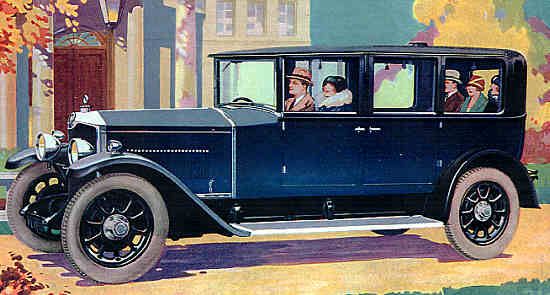
The Crossley 18/50 HP Limousine was a distinguished example of British motoring excellence in the mid-1920s, designed with a focus on refinement, durability, and formal elegance. It was produced by Crossley Motors Ltd between 1925 and 1927, alongside saloon and tourer variants of the same model range. This limousine version stood out for its longer wheelbase and enclosed, chauffeur-driven layout, which made it particularly suitable for dignitaries and high-ranking individuals.
Under the bonnet was a 2.7-litre inline six-cylinder engine, delivering around 50 brake horsepower. The engine featured an overhead valve design, a sign of advanced engineering at the time. It was paired with a four-speed manual gearbox, offering smooth and reliable performance. Though not built for high speed, the 18/50 HP was known for its refinement, ease of driving, and mechanical integrity over long distances and challenging road conditions.
The limousine body style was built to convey dignity and comfort. With an extended chassis length of 3,480 mm, the rear passenger compartment offered ample space and privacy. This area was usually separated from the driver’s compartment by a partition, and interior fittings included high-quality upholstery, wood trim, folding footrests, and other bespoke features depending on the client’s requirements. The chauffeur’s compartment, in contrast, was more utilitarian but well-built and functional.
The Crossley 18/50 HP Limousine gained international recognition when it was chosen for the 1927 Royal Tour of Australia and New Zealand. Several 18/50 HP models, including limousine versions, were used to transport the Duke and Duchess of York and their entourage. This tour required cars capable of coping with the rugged conditions and long distances of the Antipodes, and Crossley’s strong engineering proved equal to the task. The cars performed admirably, enhancing the marque’s reputation.
The limousine rode on a robust ladder-frame chassis and used semi-elliptic leaf springs for suspension. It was fitted with four-wheel mechanical brakes, a feature that provided improved stopping power compared to earlier models with only rear braking. The steering was well-suited for the car’s size and weight, though like most cars of its era, it demanded effort at lower speeds.
Only a limited number of 18/50 HP Limousines were produced, and even fewer have survived into the present day. Their rarity, combined with their royal association and historical importance, has made them prized collector’s items. Existing examples are mostly in museums or private collections, often restored to a high standard. Some are still used in vintage car events or displayed at concours d’elegance gatherings.
Today, the Crossley 18/50 HP Limousine stands as a reminder of a time when automobiles were handcrafted to meet the expectations of an elite clientele. It represents the peak of Crossley’s passenger car development and continues to impress with its dignified presence, historical significance, and refined engineering.