
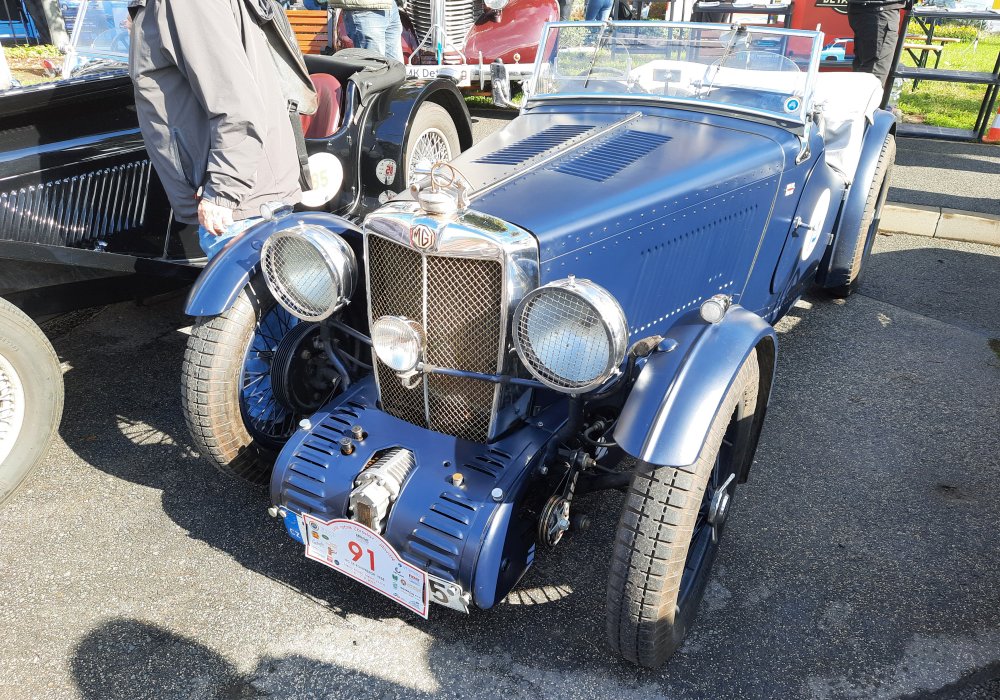
The MG TA Supercharged was a high-performance interpretation of the MG TA Midget, developed through the installation of a mechanically driven supercharger to increase the output of the standard four-cylinder engine. Based on the TA introduced in 1936, these modified cars combined the traditional appearance and lightweight construction of MG’s early T-type sports cars with considerably improved performance. Unlike the standard TA, which was a regular production model, supercharged examples were generally the result of specialist conversions or modifications undertaken by private owners and competition enthusiasts.
The MG TA Midget was introduced as the successor to the PB Midget and represented an important change in MG’s engineering philosophy. Its larger engine, improved passenger accommodation and more conventional mechanical components made it a practical and affordable sports car. However, while the standard TA offered lively performance, enthusiasts seeking greater acceleration and improved competition capabilities soon explored ways of increasing its engine output. Supercharging provided an effective solution, drawing upon a technology already associated with MG’s successful pre-war racing cars.
The standard TA was powered by a 1,292 cc inline four-cylinder engine derived from the Morris Ten. Featuring overhead valves operated by pushrods and twin SU carburettors, the engine produced approximately 50 horsepower at 4,500 rpm. Although less sophisticated than the overhead-camshaft engines used in earlier MG Midgets, it offered useful low-speed torque and relatively straightforward maintenance. Its robust construction also made it an attractive starting point for performance modifications.
Supercharged conversions typically involved fitting a mechanically driven compressor to force additional air into the engine, allowing more fuel to be burned and increasing power output. Roots-type superchargers were commonly associated with British competition cars of the period, although the equipment and installation arrangements varied between individual TA conversions. Depending on the system employed, modifications could include revised carburation, altered ignition timing, strengthened engine components and changes to the compression ratio.
The resulting improvement in performance depended heavily on the supercharger specification, boost pressure and condition of the engine. A carefully prepared supercharged TA could develop substantially more power than the standard model, providing stronger acceleration and improved performance at higher road speeds. However, there was no single universally recognised factory specification for the MG TA Supercharged, and published power figures should therefore be considered in relation to the individual vehicle and its particular conversion.
Power was transmitted to the rear wheels through the TA’s four-speed manual gearbox, which incorporated synchromesh on the upper three ratios. The increased torque produced by forced induction placed additional demands on the transmission, clutch and rear axle, particularly in cars used for competition. Owners seeking greater reliability sometimes incorporated stronger components or revised gearing to accommodate the additional engine performance.
The chassis retained the traditional MG T-type construction, employing a ladder-type steel frame with rigid front and rear axles supported by semi-elliptic leaf springs. Hydraulic shock absorbers helped control suspension movement, while hydraulically operated drum brakes provided stopping power. These features represented important improvements over earlier MG Midget designs and gave the TA a relatively capable foundation for performance development.
Although the standard chassis was suitable for enthusiastic road use, supercharged examples could require further attention to suspension settings, tyres and braking performance. The additional engine output increased the demands placed upon the vehicle, particularly during sustained high-speed driving or competition. Carefully prepared cars benefited from improvements to handling and stability, although the basic suspension arrangement remained conventional by modern standards.
Externally, the MG TA Supercharged generally retained the familiar appearance of the standard two-seat roadster. The long bonnet, upright radiator grille, separate chrome headlamps and sweeping wings gave the car its unmistakable pre-war MG character. Wire-spoked wheels, running boards and a rear-mounted spare wheel completed the traditional styling. The installation of a supercharger could introduce visible mechanical differences, including additional pipework, modified bonnet panels or alterations to the induction system, depending on the arrangement used.
Some conversions retained an almost completely standard external appearance, while others were adapted specifically for sporting competition. Competition-prepared examples might feature lightweight bodywork, reduced interior equipment, alternative windscreens or other modifications intended to improve performance. As a result, surviving supercharged TA Midgets can differ considerably in both appearance and mechanical specification.
Inside, the cockpit generally remained similar to that of the standard TA Midget. Leather-trimmed seating, a traditional dashboard and centrally arranged instrumentation provided a functional environment for the driver and passenger. The large steering wheel, floor-mounted gear lever and relatively upright driving position reflected the design conventions of the late 1930s. Competition conversions sometimes incorporated additional instruments to monitor engine performance, particularly where increased boost pressure made careful mechanical supervision desirable.
The driving experience of a supercharged TA was noticeably different from that of the naturally aspirated model. The additional engine output provided stronger acceleration and a more urgent response under load, while the mechanical sound of the supercharger added to the character of the car. The combination of increased power, narrow tyres and traditional suspension demanded careful throttle control, particularly on uneven or slippery roads.
Supercharged MGs had already achieved considerable success in motorsport before the introduction of the TA. Earlier models, including the C-type Midget, J4 Midget and K3 Magnette, demonstrated the potential of forced induction in small-capacity competition cars. Although the TA was not conceived as a dedicated racing machine, its availability and relatively straightforward mechanical construction made it a suitable platform for private competition development.
Modified TA Midgets could be found participating in trials, hill climbs, sprints and club racing, where improved engine performance offered a useful advantage. The precise competition histories of individual supercharged cars vary, and some surviving examples have been converted or further modified during later restoration work rather than during the original production period.
Production of the standard MG TA Midget continued from 1936 until 1939, with approximately 3,003 examples manufactured. The model was subsequently replaced by the MG TB Midget, which introduced the 1,250 cc XPAG engine. Unlike the standard TA, the supercharged version was not produced as a separately catalogued factory model with a definitive production total. Consequently, the number of TA Midgets fitted with superchargers during the pre-war period is difficult to establish.
Today, the MG TA Supercharged is of particular interest to enthusiasts of pre-war British sports cars and historic competition vehicles. Period conversions with documented histories can be especially desirable, particularly where original supercharging equipment and associated mechanical modifications have survived. Later conversions can also provide an exciting driving experience, although their historical significance depends upon the authenticity and provenance of the individual car.
Ownership requires careful attention to engine condition, lubrication, cooling and ignition settings. Supercharging increases the mechanical and thermal loads placed upon the engine, making correct installation and maintenance particularly important. Owners must also consider the condition of the gearbox, clutch, braking system and chassis when assessing a modified vehicle.
The MG TA Supercharged represents the enthusiasm and ingenuity of the sporting motorists who sought to extract greater performance from MG’s affordable road cars. By combining the established TA chassis with forced-induction technology, these conversions continued a tradition of lightweight, small-capacity British performance engineering. Although not a distinct factory production model, the supercharged TA remains a fascinating variation of the early T-type Midget and a reminder of MG’s close relationship with the world of amateur motorsport.
Create image