
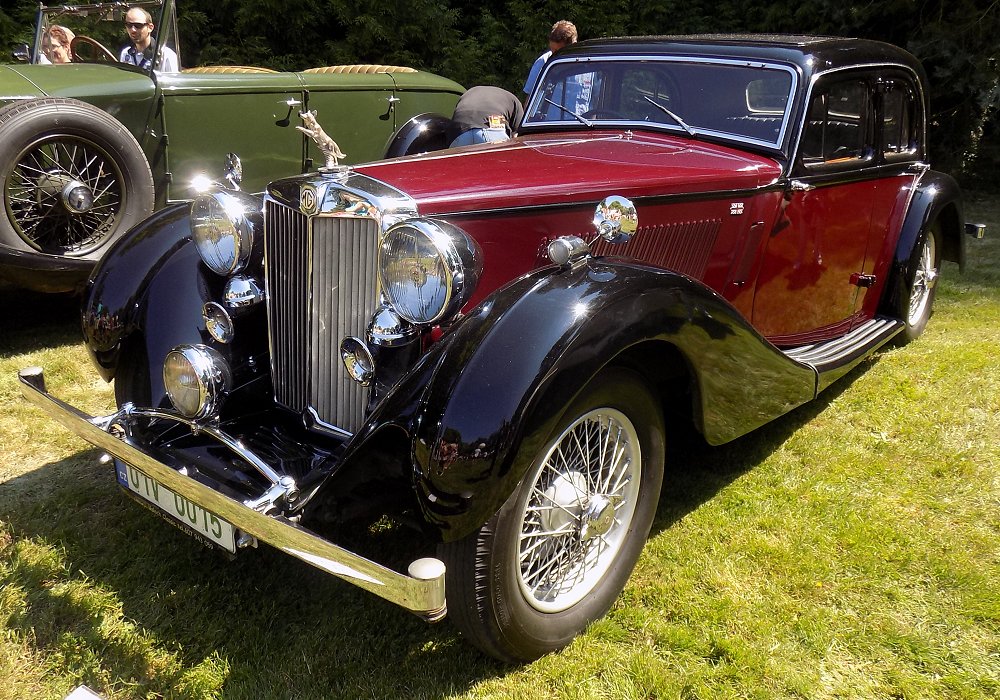
The MG SA Saloon was introduced in 1936 as the flagship model of the MG range, representing a significant departure from the company’s established reputation for small, lightweight sports cars. Designed to compete in the increasingly important market for refined sporting saloons, the SA combined elegant coachwork, a smooth six-cylinder engine and spacious accommodation with the distinctive character associated with the MG marque. It was one of the largest and most luxurious vehicles produced by MG before the Second World War and demonstrated the company’s ambition to compete with established manufacturers of prestigious British motor cars.
Development of the MG SA began during the mid-1930s, when MG was undergoing substantial organisational changes following its integration into the Nuffield Organisation. The company sought to expand beyond its traditional sports car market by introducing larger and more sophisticated vehicles capable of appealing to professional motorists and affluent families. The SA was originally developed under the project designation EX150 and was intended to combine the comfort of a luxury saloon with the responsive performance expected from an MG.
The SA was powered initially by a 2,062 cc inline six-cylinder engine featuring overhead valves operated by pushrods. Derived from Wolseley engineering, the engine was modified for MG applications and equipped with twin SU carburettors. Early production cars developed approximately 75 horsepower, providing smooth and flexible performance suitable for a large sporting saloon. The six-cylinder configuration offered considerably greater refinement than the smaller four-cylinder engines used in MG’s Midget models, making the SA particularly well suited to long-distance touring.
During production, the engine was enlarged to 2,288 cc, providing improved torque and flexibility. Although the SA was not intended to deliver the outright acceleration of a lightweight sports car, its larger engine offered relaxed cruising and sufficient performance for enthusiastic driving. Depending on specification and conditions, the car was capable of reaching approximately 80 mph (129 km/h), a respectable maximum speed for a substantial British saloon of the late 1930s.
Power was transmitted to the rear wheels through a four-speed manual gearbox incorporating synchromesh on the upper ratios. The transmission was designed to provide smooth operation and make effective use of the engine’s flexible power delivery. The combination of the six-cylinder engine and conventional rear-wheel-drive layout gave the SA a refined and predictable driving character, particularly on the open roads for which it was intended.
The chassis employed a substantial ladder-frame construction, designed to support the larger and heavier bodywork of the SA range. Suspension consisted of rigid front and rear axles supported by semi-elliptic leaf springs, with hydraulic shock absorbers controlling movement. Hydraulic drum brakes provided stopping power, offering improved consistency and control compared with the mechanical braking systems fitted to many earlier MG models.
Although the suspension design was conventional, the long wheelbase and substantial chassis contributed to stable road behaviour and a comfortable ride. The SA was intended primarily as a sporting touring car rather than a competition machine, and its engineering reflected the importance of passenger comfort, refinement and durability. Nevertheless, its responsive steering and relatively powerful engine ensured that it retained a degree of the sporting character associated with MG.
The MG SA Saloon was particularly notable for its elegant and imposing bodywork. Its long bonnet, prominent upright radiator grille and sweeping front wings created a distinguished appearance that reflected contemporary British luxury car styling. Large chrome headlamps, wire-spoked wheels and carefully proportioned body panels contributed to its refined character, while the distinctive MG radiator design preserved a clear connection with the company’s sporting heritage.
The four-door saloon body provided generous accommodation for both front and rear passengers. Its flowing roofline, substantial doors and spacious passenger compartment gave the car an appearance of elegance and solidity. The rear bodywork was carefully integrated into the overall design, while the long wheelbase allowed the passenger cabin to be positioned comfortably between the axles.
Inside, the SA Saloon offered a level of luxury considerably greater than that found in MG’s smaller sports cars. The cabin featured leather upholstery, polished wood trim and high-quality interior fittings, reflecting the expectations of buyers in the upper-middle-class sporting saloon market. The dashboard incorporated traditional instruments, including a speedometer, engine gauges and other controls, arranged within an attractive wooden fascia.
The front seats provided comfortable accommodation for the driver and passenger, while the rear compartment offered sufficient space for adult occupants. Generous headroom and legroom made the SA suitable for extended journeys, and the enclosed body provided effective protection from the weather. Interior detailing emphasised craftsmanship and comfort, helping distinguish the SA from more utilitarian family saloons.
The driving experience was characterised by smooth six-cylinder performance, a relatively relaxed engine character and stable handling. Although the SA was considerably larger and heavier than MG’s sports car models, its engine provided sufficient power for confident touring. The long wheelbase contributed to a comfortable ride, while the hydraulic braking system and conventional steering arrangement offered predictable control.
The SA Saloon was also available alongside other body styles within the range, including the elegant Tickford Drophead Coupé and open tourer versions. These alternatives broadened the model’s appeal and demonstrated the versatility of the underlying chassis. The Tickford Drophead Coupé, with coachwork by Salmons & Sons, was particularly distinctive, offering a combination of luxury and open-air motoring.
The MG SA competed in a market occupied by established British manufacturers such as Riley, Alvis and SS Cars, the latter subsequently becoming Jaguar. These companies offered sporting saloons combining performance, comfort and attractive styling, making the segment highly competitive. Although MG was better known for smaller sports cars, the SA demonstrated that the company could produce a credible alternative in this more prestigious category.
Production of the MG SA continued until 1939, when the outbreak of the Second World War brought civilian vehicle manufacturing to a halt. Approximately 2,738 examples were produced across the various body styles, making the SA a relatively uncommon model compared with MG’s smaller sports cars. The saloon accounted for a substantial proportion of production, reflecting the importance of the model’s practical and luxurious character.
The SA was followed in MG’s larger-car development by the WA, introduced in 1938. The WA featured a larger engine and more substantial bodywork, representing a further attempt to compete in the luxury sporting saloon market. However, the outbreak of war interrupted MG’s development of large saloons, and the company subsequently concentrated increasingly on smaller sports cars and more conventional family models.
Today, the MG SA Saloon is highly regarded among collectors of pre-war British luxury and sporting cars. Its elegant styling, smooth six-cylinder engine and relatively limited production make it an attractive alternative to better-known contemporary models. Surviving examples are valued for their historical significance, traditional craftsmanship and association with MG’s ambitious expansion during the 1930s.
Restoration of an SA Saloon can be demanding because of its complex coachwork, extensive interior trim and the availability of model-specific mechanical components. The preservation of original woodwork, leather upholstery, exterior fittings and period-correct details is particularly important. Well-restored examples demonstrate the quality and refinement that MG sought to achieve in its flagship pre-war models.
The MG SA Saloon represents an important chapter in the history of the MG marque. By combining a substantial six-cylinder engine, elegant four-door coachwork and luxurious accommodation, it demonstrated the company’s ability to move beyond lightweight sports cars into the prestigious sporting saloon market. Although its production life was relatively short, the SA remains a distinguished example of British automotive design during the late 1930s and a reminder of MG’s broader ambitions before the Second World War.