
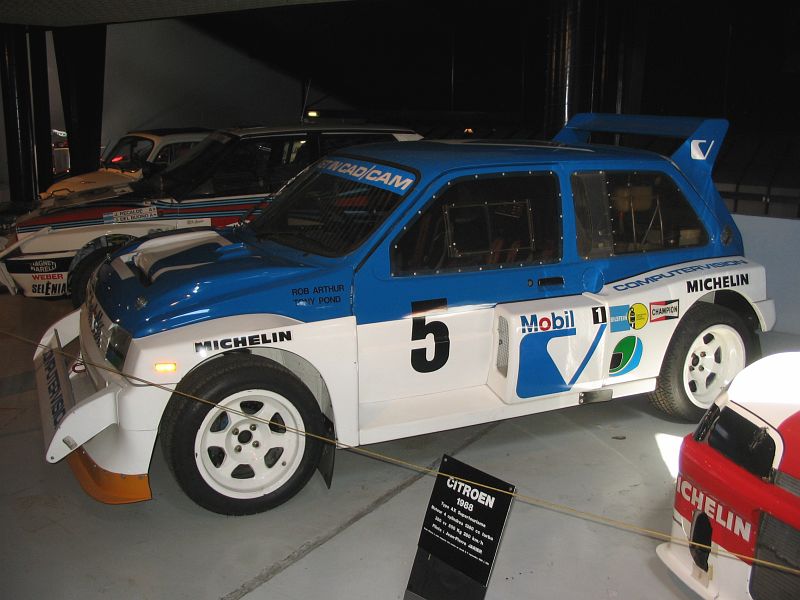
The MG Metro 6R4 was one of the most extraordinary competition cars developed by the British motor industry during the 1980s. Created by Austin Rover Motorsport in collaboration with Williams Grand Prix Engineering, it was designed to compete in the highly competitive Group B category of international rallying. Although its appearance was loosely based on the familiar MG Metro supermini, the 6R4 was an entirely different machine, featuring a purpose-built chassis, a mid-mounted 3.0-litre V6 engine, permanent four-wheel drive and dramatic aerodynamic bodywork. Introduced in 1985, the Metro 6R4 combined advanced competition engineering with a distinctive naturally aspirated engine at a time when many rival manufacturers were relying on turbocharging. Despite its relatively short international rallying career, the Metro 6R4 became one of the most recognisable and celebrated British rally cars of the Group B era.
The origins of the MG Metro 6R4 can be traced to the early 1980s, when British Leyland was attempting to restore the sporting reputation of the MG marque. Following the closure of the MG factory at Abingdon in 1980 and the discontinuation of the MGB, the company revived the MG name for performance versions of its modern passenger cars, beginning with the MG Metro in 1982.
At the same time, international rallying was undergoing a technological revolution. The introduction of Group B regulations in 1982 encouraged manufacturers to develop highly specialised competition cars with relatively limited production requirements. These regulations allowed considerable freedom in engine design, chassis construction and drivetrain layout, resulting in some of the most powerful and sophisticated rally cars ever built.
The Audi Quattro had already demonstrated the advantages of four-wheel drive in rallying, while manufacturers such as Lancia and Peugeot were developing increasingly advanced machines. The Peugeot 205 Turbo 16, introduced during the mid-1980s, established new standards for compact, mid-engined rally cars.
Austin Rover recognised that a conventional front-wheel-drive Metro would be unable to compete against these vehicles. The company therefore embarked on an ambitious programme to create an entirely new rally car using the Metro’s basic appearance as a marketing connection.
The project became known as the MG Metro 6R4, with the designation referring to its six-cylinder engine and four-wheel-drive configuration. The car was developed in two principal forms: the lower-powered Clubman version, produced to satisfy homologation requirements, and the more powerful International specification intended for top-level competition.
Development began in 1983, with Williams Grand Prix Engineering commissioned to undertake much of the chassis and suspension development. Williams brought considerable expertise from Formula One, particularly in lightweight construction, vehicle dynamics and competition engineering.
Austin Rover Motorsport directed the overall programme, coordinating engine development, testing and competition preparation. The objective was to produce a compact, powerful and highly manoeuvrable rally car capable of competing against the increasingly sophisticated Group B opposition.
One of the most unusual engineering decisions was the choice of a naturally aspirated V6 engine rather than a turbocharged four-cylinder or five-cylinder power unit. Many contemporary Group B cars relied on turbocharging to produce enormous power outputs, but Austin Rover believed that a naturally aspirated engine could offer significant advantages.
These included immediate throttle response, predictable power delivery and reduced mechanical complexity. Turbocharged rally cars of the period frequently suffered from turbo lag, making precise throttle control difficult on narrow and technical rally stages.
A naturally aspirated engine could provide a more linear power curve, allowing the driver to control wheelspin and acceleration more precisely. This was considered particularly valuable when combined with a short-wheelbase chassis and permanent four-wheel drive.
The resulting engine was the specially developed V64V, a 2,991 cc V6 designed specifically for the Metro 6R4 programme. It featured six cylinders arranged in a 90-degree V configuration, with double overhead camshafts and four valves per cylinder.
The engine employed an aluminium-alloy cylinder block and cylinder heads, reducing weight while providing the strength necessary for high-performance competition use. The advanced cylinder-head design allowed efficient airflow and high engine speeds, contributing to its substantial power output.
In Clubman specification, the V64V engine developed approximately 250 bhp, providing exceptional performance for a compact car of the period. The International competition version was substantially more powerful, producing approximately 400 to 410 bhp at high engine speeds.
The naturally aspirated engine provided immediate throttle response without the turbo lag associated with contemporary forced-induction rally cars. This characteristic was particularly valuable on narrow and technical rally stages, where rapid changes in engine speed and precise throttle control were essential.
The V6 engine was mounted longitudinally behind the passenger compartment, occupying the space normally used for the rear seats and luggage compartment in the production Metro. This mid-engine arrangement helped centralise the vehicle’s mass and improve weight distribution.
Power was transmitted through a specially developed five-speed manual gearbox and permanent four-wheel-drive system. The drivetrain incorporated front and rear differentials, allowing engine torque to be distributed between all four wheels.
The four-wheel-drive arrangement provided exceptional traction on loose surfaces, including gravel, mud and snow. It also allowed the Metro 6R4 to accelerate strongly out of corners, where conventional two-wheel-drive rally cars could struggle to transmit their power effectively.
The competition version was equipped with strengthened transmission components designed to withstand the high torque loads and repeated acceleration demands of international rallying. Gear ratios and differential settings could be adapted to suit different events and surfaces.
The MG Metro 6R4 was capable of extraordinary acceleration. In International specification, acceleration from 0 to 60 mph could be achieved in approximately 3 seconds, depending on gearing and surface conditions. The lower-powered Clubman version generally required around 4.5 to 5 seconds.
Maximum speed varied considerably according to the gearing selected for individual events. Unlike conventional road cars, the Metro 6R4 was designed primarily for rapid acceleration, cornering performance and short bursts of high speed rather than sustained maximum-speed cruising.
The chassis was one of the most advanced aspects of the Metro 6R4 programme. Williams developed a purpose-built steel spaceframe incorporating extensive reinforcement and carefully positioned suspension mounting points.
The spaceframe provided a strong and relatively lightweight foundation for the engine, transmission and suspension. Its design also allowed the vehicle’s dimensions and weight distribution to be optimised specifically for rallying.
The bodywork was constructed using lightweight composite materials, including glass-reinforced plastic panels. Although the central passenger compartment retained some visual resemblance to the production Metro, the remainder of the body was substantially redesigned.
The Metro 6R4 featured dramatically widened wheel arches, deep side skirts, large front air intakes and prominent aerodynamic devices. These modifications accommodated the wide track, competition suspension and substantial wheels while also contributing to aerodynamic stability.
The front end incorporated a deep air dam and large cooling openings, while the rear featured a prominent roof-mounted spoiler and additional aerodynamic structures. The resulting appearance was far more aggressive than that of the ordinary Metro.
The car’s compact passenger compartment, enormous wheel arches and exaggerated aerodynamic features created one of the most recognisable silhouettes of the Group B era.
Despite its radical construction, the Metro 6R4 retained enough styling elements from the production Metro to establish a visual connection with the road car. The windscreen shape, roofline and certain front-end features helped maintain the family resemblance.
The Metro 6R4 was designed primarily for competition use. Although the Clubman version could occasionally be registered for road use, the car was not intended as a conventional passenger vehicle.
The interior was consequently extremely basic. The passenger compartment incorporated competition-style seats, safety harnesses and essential instrumentation. In International specification, additional safety equipment and competition controls were fitted.
The dashboard was designed to provide the driver and co-driver with the information required during competition. Additional switches and controls operated the electrical systems, fuel pumps and other specialised equipment.
The steering wheel, gear lever and pedals were positioned to provide precise control during demanding rally stages. The driver sat relatively close to the centre of the vehicle, with the powerful V6 engine mounted immediately behind the passenger compartment.
Noise levels were extremely high, particularly because of the proximity of the engine and the limited sound insulation. The naturally aspirated V6 produced a distinctive high-pitched exhaust note at elevated engine speeds, contributing to the car’s unmistakable character.
The suspension was designed specifically for rally competition. Independent suspension was employed at all four corners, with double wishbones and coil springs providing precise wheel control.
The suspension geometry allowed substantial wheel travel while maintaining effective tyre contact with uneven surfaces. This was essential for rallying, where the vehicle needed to negotiate rough roads, jumps and rapidly changing grip conditions.
Adjustable dampers and suspension settings allowed the Metro 6R4 to be configured for different surfaces and competition requirements. Gravel, tarmac and mixed-surface events demanded different combinations of ride height, spring rates and damping characteristics.
The braking system employed large ventilated disc brakes at all four wheels, providing the stopping power necessary for a high-performance rally car. Competition brake components were designed to withstand repeated heavy use under demanding conditions.
The Metro 6R4 was fitted with wide competition wheels and tyres, with specifications varying according to the intended event. The substantial wheel-arch extensions allowed the installation of much wider tyres than those fitted to the standard Metro.
The four-wheel-drive system, wide track and advanced suspension contributed to exceptional traction and cornering performance. However, the car’s short wheelbase and powerful engine also demanded considerable skill from the driver, particularly on loose surfaces.
The Metro 6R4’s handling was characterised by rapid responses, strong acceleration and excellent traction. The naturally aspirated engine provided immediate throttle control, while the permanent four-wheel-drive system allowed the driver to exploit the available power effectively.
The absence of turbo lag gave the Metro 6R4 a distinctive advantage in certain conditions. Drivers could apply power progressively and predictably, particularly when exiting tight corners or negotiating technical sections of rally stages.
The development programme progressed rapidly during 1984 and 1985, with extensive testing undertaken to refine the chassis, engine and drivetrain. Austin Rover Motorsport entered prototype and development cars in selected events to evaluate their performance under competition conditions.
The Metro 6R4 made its most significant early appearance in the 1985 RAC Rally, where Tony Pond and co-driver Rob Arthur finished third overall. This was an impressive result for a newly developed car and demonstrated the potential of the naturally aspirated V6 and four-wheel-drive chassis.
The result generated considerable publicity for Austin Rover and the MG marque. It also suggested that the Metro 6R4 could become a competitive alternative to the turbocharged Group B cars produced by rival manufacturers.
The 1986 season marked the Metro 6R4’s principal involvement in the World Rally Championship. Austin Rover entered the car in selected events, seeking to establish its competitiveness against manufacturers such as Peugeot, Lancia, Audi and Ford.
However, the Metro 6R4 faced significant challenges. The naturally aspirated V6, although responsive and powerful, could not always match the outright performance of the most advanced turbocharged rivals, some of which were producing more than 500 bhp.
Mechanical reliability also proved problematic during the car’s early international career. Engine and drivetrain failures affected several events, limiting the results achieved by the factory team.
The short development period and rapid escalation of Group B performance placed considerable pressure on Austin Rover Motorsport. The Metro 6R4 required further refinement to achieve the reliability and competitiveness necessary for sustained success at world championship level.
The 1986 World Rally Championship season was overshadowed by a series of serious accidents that raised fundamental concerns about the safety of Group B rallying.
Following the fatal accident involving Henri Toivonen and Sergio Cresto during the Tour de Corse, the international governing body announced that Group B would be discontinued at the end of the 1986 season.
This decision brought the Metro 6R4’s intended international competition career to a premature end. The car had only recently entered full competition when the regulations under which it had been developed were abandoned.
The sudden cancellation of Group B left Austin Rover with a substantial investment in the Metro 6R4 programme and a number of completed vehicles and components. The company subsequently offered remaining cars and parts for sale, allowing private competitors to acquire the sophisticated machinery.
Although the Metro 6R4’s World Rally Championship career was brief, the car subsequently enjoyed considerable success in other forms of motorsport.
The Metro 6R4 proved particularly effective in rallycross, where its compact dimensions, strong traction and naturally aspirated engine were well suited to short, demanding races.
Modified Metro 6R4s competed successfully in British and European rallycross championships, often receiving further engine development and chassis modifications. Some examples were fitted with substantially more powerful engines, allowing them to remain competitive against newer machinery.
The Metro 6R4 also continued to compete in national rally championships and specialist motorsport events. Its advanced four-wheel-drive system and responsive engine made it particularly effective on technical stages.
The Clubman version played an important role in this continued competition activity. Although originally intended as a homologation model, many examples were upgraded to higher performance specifications or extensively modified for specialist competition use.
The V64V engine also influenced later developments within the British motor industry. Its basic architecture contributed to the development of the twin-turbocharged V6 engine used in the Jaguar XJ220, demonstrating the sophistication and potential of the original Austin Rover competition design.
The MG Metro 6R4 programme produced approximately 200 homologation Clubman cars, together with a much smaller number of International competition vehicles and development prototypes. The exact number of International-specification cars is difficult to establish because some Clubman vehicles were subsequently upgraded to competition specification.
This limited production, combined with the car’s association with Group B rallying, has made the Metro 6R4 one of the most desirable MG competition models.
Today, the MG Metro 6R4 is regarded as one of the most distinctive British rally cars ever produced. Its naturally aspirated V6 engine, permanent four-wheel-drive system and dramatic bodywork distinguish it from the turbocharged Group B machines developed by rival manufacturers.
Surviving examples are highly valued, particularly those retaining original factory specifications or possessing documented competition histories. Cars associated with significant events, drivers or factory development programmes are especially desirable.
Restoration and maintenance require specialist knowledge because the Metro 6R4 shares relatively few mechanical components with the ordinary production Metro. The spaceframe chassis, competition suspension, four-wheel-drive transmission and V64V engine were developed specifically for the rally programme.
The high-output V6 engine requires careful maintenance, particularly concerning lubrication, cooling and valve-train components. Replacement parts can be expensive and difficult to obtain, while specialist engineering work may be necessary to manufacture components that are no longer available.
The transmission and differential assemblies also require careful inspection, particularly on cars that have been used extensively in competition. High torque loads, aggressive driving and repeated hard acceleration can place considerable stress on the drivetrain.
The spaceframe chassis should be examined for corrosion, accident damage and fatigue, particularly around suspension mounting points and structural joints. Composite body panels can also suffer from cracking or damage, although repairs are generally possible using appropriate specialist techniques.
Originality is an important consideration when assessing a Metro 6R4. Many surviving cars have been modified for competition, with changes to engines, transmissions, suspension and bodywork. Chassis identification, historical documentation and competition records are therefore essential when establishing a vehicle’s provenance.
The MG Metro 6R4 represents one of the most ambitious engineering projects undertaken by the British motor industry during the 1980s. Developed through a collaboration between Austin Rover Motorsport and Williams Grand Prix Engineering, it combined a purpose-built chassis, sophisticated permanent four-wheel drive and a high-revving naturally aspirated V6 engine within a compact body loosely inspired by the ordinary Metro supermini. Although the cancellation of Group B prevented the car from achieving its full international rallying potential, its remarkable engineering and subsequent success in national competition secured its place in motorsport history. The Metro 6R4 remains one of the most extraordinary vehicles ever to carry the MG badge and an enduring symbol of the technological ambition that defined Group B rallying.