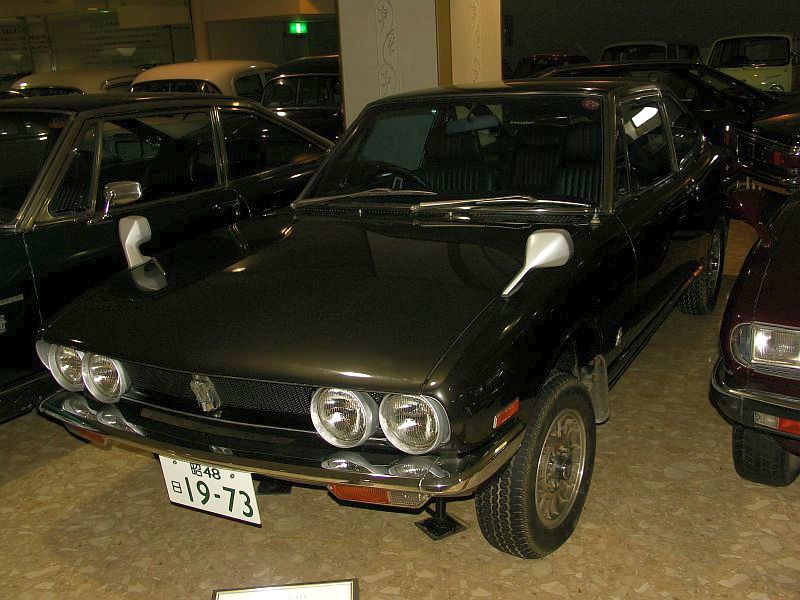
Isuzu 117 Coupé 1800
The Isuzu 117 Coupé 1800 represented the second evolution of Isuzu’s most refined and artistically designed car, carrying forward the timeless elegance of Giorgetto Giugiaro’s original 117 design while introducing mechanical and production improvements that broadened its appeal. Introduced in 1973, the 1800 replaced the earlier 1600 model and marked a shift from the exclusive, hand-built era of the late 1960s toward a more industrialized, yet still luxurious, form of production. With its new 1.8-litre engine and improved manufacturing methods, the 117 Coupé 1800 balanced beauty and precision with greater accessibility, making one of Japan’s most admired automobiles available to a wider audience without compromising its essence.
When the 117 first appeared in 1968, it was an artisanal machine — a car hand-assembled in limited numbers, finished with leather and wood, and priced far beyond the reach of most buyers. By the early 1970s, however, Isuzu recognized the need to adapt the model for a changing market. Japan’s economy was growing rapidly, and a new class of buyers sought cars that reflected both taste and modern sophistication. At the same time, rising production costs and stricter emissions standards made the continuation of small-scale hand-built cars impractical. The introduction of the 117 Coupé 1800 addressed these realities, updating the mechanicals while retaining the Italian-inspired form that had made the car an icon.
Externally, the 117 Coupé 1800 remained almost unchanged from the earlier PA90 series. The flowing bodywork, penned by Giugiaro during his tenure at Ghia, retained its perfectly proportioned balance of long bonnet, low beltline, and gracefully tapering tail. The simple horizontal grille with twin circular headlamps, slender bumpers, and large glass area gave the car an understated but unmistakable presence. Minor trim updates distinguished the newer version, such as revised badging and slightly different wheel designs, but the 117’s essential beauty remained untouched — a testament to the timelessness of its original form.
The major change lay under the bonnet. The 1800 introduced the G180 engine, a 1,817 cc inline-four developed from Isuzu’s proven G-series architecture. Like its predecessor, it employed a twin overhead camshaft design, but the new unit offered smoother power delivery and improved torque across the rev range. Output varied slightly depending on specification and market, but in standard twin-carburetor form the engine produced around 115 horsepower, with fuel-injected versions later reaching 130 horsepower. The increased displacement gave the car more flexible performance, making it easier and more relaxed to drive at everyday speeds while maintaining the free-revving character that had defined the earlier 1600.
Power was transmitted to the rear wheels through either a four-speed or five-speed manual gearbox, depending on the model year, while a three-speed automatic became available for buyers who prioritized comfort. The combination of a torquey engine and relatively light body made the 117 Coupé 1800 an effortless cruiser, capable of speeds approaching 190 km/h in manual form.
The chassis and suspension continued the proven configuration of the 1600: independent front suspension with double wishbones and coil springs, and a live rear axle located by trailing arms and coil springs. While this setup was not cutting-edge by European grand touring standards, it was carefully tuned to deliver a refined, composed ride that matched the car’s elegant character. The 117’s long wheelbase and low center of gravity contributed to exceptional stability, and revisions to the shock absorbers and bushings in the 1800 improved both comfort and body control. Front disc brakes and rear drums provided dependable braking performance, while power-assisted steering was introduced on higher trims, adding to the car’s sense of effortless control.
Inside, the 117 Coupé 1800 reflected Isuzu’s continuing commitment to craftsmanship, even as production volume increased. The dashboard was redesigned with more modern instrumentation, though it retained the traditional wood veneer finish that gave the interior warmth and distinction. The seating was reshaped for greater comfort, with higher-quality fabrics or leather available on luxury trims. Later examples introduced air conditioning, improved sound insulation, and additional convenience features that placed the car firmly in the upper tier of Japanese motoring. Despite the shift to semi-automated production, the fit and finish of the 117’s cabin remained excellent, preserving the sense of intimacy and refinement that defined the model.
Driving the 117 Coupé 1800 revealed the car’s dual nature: part grand tourer, part sports coupé. The new engine provided stronger mid-range power and smoother cruising ability, while retaining the responsive character of the original. The gearbox, light clutch, and well-weighted steering made the car a pleasure to drive both in city traffic and on winding roads. The ride was supple and quiet, and the car’s balance inspired confidence even at high speeds. It was not an aggressive sports machine but rather a car that combined composure with precision — one that could be driven briskly without strain, embodying a kind of mechanical grace that few others of its time achieved.
The introduction of the 1800 also coincided with a shift in production philosophy. Earlier 117s had been almost bespoke in nature, but beginning in 1973, Isuzu adopted automated assembly processes at its Fujisawa plant, allowing output to increase from a few hundred units per year to several thousand. This made the 117 more attainable, though the car never lost its air of quiet exclusivity. It appealed to professionals, artists, and academics — individuals who valued design and craftsmanship over flamboyance.
The Isuzu 117 Coupé 1800 remained in production through the mid-1970s and eventually evolved into the 2000-series models, which continued into the early 1980s. Despite its long production life, the essential design and character of the 117 never dated. It continued to be admired for its combination of elegance, technical sophistication, and restraint.
Today, the 117 Coupé 1800 occupies an important place in Japan’s motoring heritage. It represents the maturation of Isuzu’s design and engineering identity — a car that demonstrated that beauty and practicality could coexist, and that Japanese craftsmanship could stand proudly alongside the finest European traditions.
The 117 Coupé 1800 was not just an update; it was the point at which the car reached equilibrium — still graceful, still finely made, but more usable and versatile. It remains one of the most refined expressions of Japan’s golden age of motoring, a car of enduring style, quiet confidence, and timeless charm.
