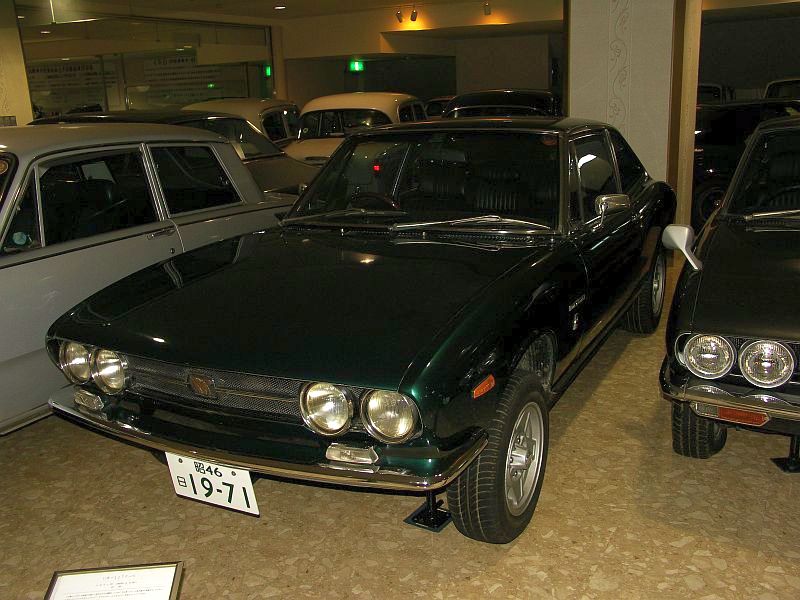
Isuzu 117 Coupé 1600
The Isuzu 117 Coupé 1600 was the original production version of one of Japan’s most graceful and influential automobiles. Introduced in 1968, it marked Isuzu’s transition from a respected but modest manufacturer into a builder of truly world-class cars. Designed by Giorgetto Giugiaro at Ghia and powered by one of the most advanced engines ever fitted to a Japanese production vehicle of its time, the 117 Coupé 1600 blended Italian artistry with Japanese precision. It was not merely a sports car or a grand tourer — it was a statement of craftsmanship, refinement, and design integrity that would remain unmatched for decades.
The 117 Coupé began as a styling exercise in 1966, commissioned by Isuzu to showcase what an elegant Japanese two-door could look like. Giugiaro, then only in his mid-twenties, created a design that was both fluid and restrained, combining European sophistication with subtle Japanese understatement. The prototype, first shown at the 1966 Geneva Motor Show, received widespread praise for its perfect proportions and graceful simplicity. Two years later, Isuzu introduced the production version largely unchanged — a remarkable achievement that underscored both the quality of the design and the company’s determination to preserve its artistic integrity.
The 117 Coupé 1600, coded PA90, was built on a shortened version of the Isuzu Florian sedan platform, but it shared little with its sibling beyond basic structure. The bodywork was hand-assembled, with fine attention to panel fit and finish, especially in the earliest examples. Its shape was pure Giugiaro: a long bonnet, low waistline, delicately curved roof, and an elegant rear taper that gave the car a poised, timeless stance. The front featured twin round headlamps set within a clean, horizontal grille, framed by slender chrome bumpers. The rear was understated, with simple round taillights and subtle chrome details. It was one of the few Japanese cars of its time that could stand confidently beside contemporary European designs such as the Fiat Dino or Lancia Fulvia Coupé.
Under the bonnet, the 117 Coupé 1600 was powered by the Isuzu G161W engine — a 1,587 cc inline four-cylinder with twin overhead camshafts and a crossflow aluminum head. This was a remarkable engine for a Japanese manufacturer in the 1960s, as only a handful of European exotics offered similar technology. In standard tune with twin side-draught carburetors, it produced around 120 horsepower at 6,400 rpm — enough to propel the car to a top speed of around 185 km/h. The engine’s refinement was one of its most impressive qualities: it revved smoothly, delivered power progressively, and emitted a distinctive mechanical note that reinforced the car’s sense of precision and sophistication.
Power was sent to the rear wheels through a four-speed manual gearbox, with a five-speed transmission offered on later versions. The combination of a free-revving engine and close-ratio gearing gave the 117 Coupé 1600 a lively and responsive character. Despite its elegance, it was a car that could be driven hard, and its chassis rewarded those who appreciated balance and delicacy over brute force.
The suspension layout was conventional but well executed, with independent double wishbones and coil springs at the front, and a live rear axle located by trailing arms and coil springs. The ride was supple, and the handling neutral and predictable. The car’s compact dimensions and relatively low weight gave it agility, while its long wheelbase ensured stability at speed. Braking was by front discs and rear drums — effective for the time, and more than adequate given the car’s refinement-oriented nature.
Inside, the 117 Coupé 1600 offered an interior that rivalled contemporary Italian and British grand tourers. The early hand-built models were finished to an exceptional standard: genuine wood veneers adorned the dashboard, high-quality leather or velour covered the seats, and chrome details were applied with restraint. The driving position was low and intimate, the instruments clearly laid out, and the overall atmosphere one of quiet luxury. The cockpit reflected the car’s dual character — sporty yet dignified — a space designed for long journeys as much as for spirited drives on winding roads.
Driving the 117 Coupé 1600 was an experience defined by refinement. The DOHC engine was smooth and flexible, offering a wide band of usable power. The gearbox shifted with precision, and the steering was light but communicative. On the open road, the car felt poised and unhurried, its suspension absorbing imperfections with ease. It was not the fastest car in its class, but few matched its composure or its sense of mechanical polish. The car’s dynamic balance and quiet confidence made it a favorite among discerning drivers who valued sophistication over raw performance.
Because of the car’s semi-handcrafted nature, early production was slow. The 117 Coupé 1600 was built in limited numbers at Isuzu’s Fujisawa plant, with only a few hundred units produced annually during its first years. Its price was high by Japanese standards — roughly equivalent to that of a luxury European import — and it appealed to a select clientele of professionals, artists, and executives. However, its exclusivity became part of its allure. The car’s design was so admired that it remained in production for over a decade with only minor cosmetic changes, an extraordinary lifespan for any vehicle, let alone one so finely detailed.
The 117 Coupé’s influence extended beyond its own production run. It established Isuzu as a manufacturer capable of building cars that combined engineering excellence with design beauty, paving the way for later collaborations with Giorgetto Giugiaro, including the 1980s Isuzu Piazza. It also helped define a uniquely Japanese approach to the grand touring concept — one that emphasized balance, craftsmanship, and quiet refinement rather than excess.
Today, the Isuzu 117 Coupé 1600 is regarded as a design icon and a cornerstone of Japan’s automotive heritage. Its timeless styling, advanced twin-cam engine, and impeccable build quality make it one of the most collectible classic Japanese cars of the era. Early PA90 1600 models, particularly the hand-built examples, are especially prized for their rarity and purity of design.
The 117 Coupé 1600 remains a masterclass in restraint and proportion — a car that demonstrated Japan’s ability to create beauty through precision and understatement. It stands as a milestone in Isuzu’s history and as one of the great examples of cross-cultural design harmony: Italian elegance shaped by Japanese discipline, resulting in a machine that still embodies the essence of refined motoring half a century later.
