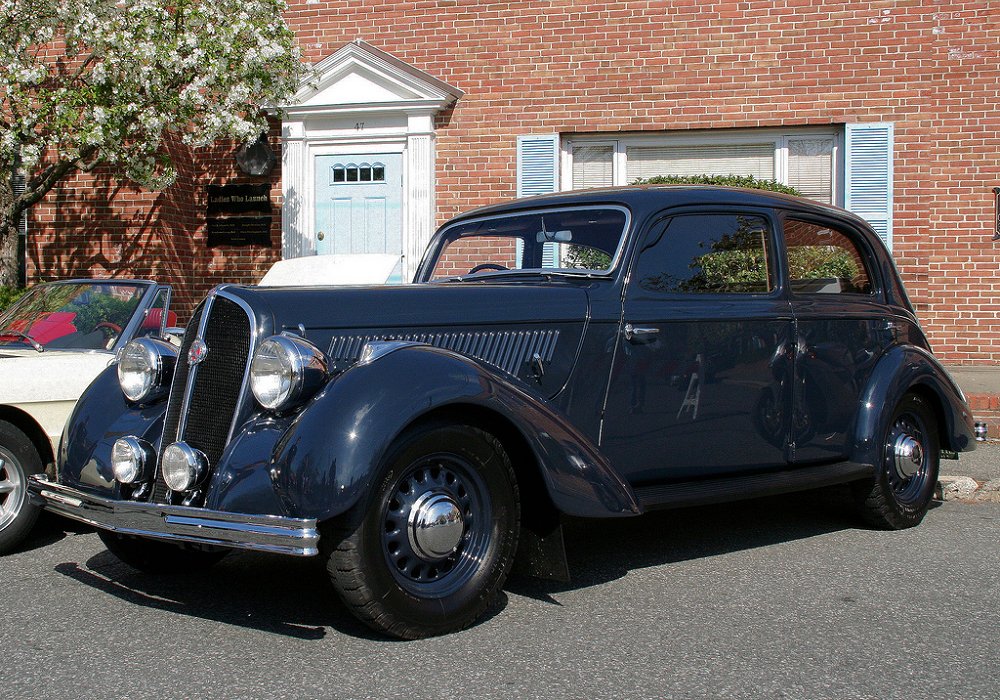
Hotchkiss 686
The Hotchkiss 686 was one of the finest French luxury touring cars of the late 1930s, embodying the marque’s renowned blend of mechanical excellence, elegant restraint, and dependable performance. Introduced in 1936 as part of Hotchkiss’s prestigious “6-cylinder” range, the 686 occupied a distinguished place in the company’s lineup, offering a harmonious combination of power, comfort, and sophistication at a time when French motoring design was reaching its peak.
Hotchkiss, whose name had become synonymous with precision engineering and reliability, designed the 686 as an evolution of the earlier 620 and 680 models. The car was powered by a robust 3.5-litre inline six-cylinder engine with an overhead-valve configuration. Delivering around 120 horsepower in its higher-performance variants, it provided smooth and effortless acceleration with a top speed of roughly 140 km/h (87 mph)—excellent performance for a car of its class and weight. The engine was known for its refinement, flexibility, and mechanical quietness, qualities that made it a favorite among long-distance drivers and professional chauffeurs alike.
The chassis was built to the same exacting standards that had earned Hotchkiss its reputation for durability. Constructed from high-tensile steel, it offered both strength and balance, making the car exceptionally stable and comfortable even on poor roads. The suspension system employed independent front suspension with coil springs—a modern feature for its time—combined with a live rear axle and semi-elliptic leaf springs to provide a smooth, controlled ride. Hydraulic drum brakes on all four wheels ensured reliable stopping power, while the four-speed manual gearbox shifted with the crisp precision that was a hallmark of the marque.
The styling of the 686 reflected the quiet dignity of prewar French design. Its long, flowing bonnet, tall radiator grille with the Hotchkiss badge, and sweeping front fenders gave it a commanding yet elegant presence. The design evolved slightly over its production run, incorporating more streamlined elements by 1938 as aerodynamics began to influence luxury car aesthetics. The 686 was offered in several configurations, including four-door sedans, coupés, cabriolets, and limousines—many of which were bodied by leading French coachbuilders such as Henri Chapron, Kellner, or Letourneur et Marchand. Each example was handcrafted, often tailored to its owner’s specifications, resulting in a car that was both technically advanced and highly individual.
Inside, the 686 continued Hotchkiss’s tradition of understated refinement. The interiors were appointed with high-quality materials such as fine leather upholstery, polished walnut or mahogany trim, and clear, well-arranged instrumentation. The dashboard was functional but elegant, reflecting the company’s philosophy that form should follow mechanical excellence. Rear-seat comfort was excellent, with generous legroom and superb visibility, while sound insulation ensured a tranquil cabin even at high speeds.
On the road, the 686 was admired for its effortless composure. The six-cylinder engine delivered smooth torque from low revs, allowing for easy, relaxed cruising. The steering was precise and well weighted, giving the driver confidence on winding roads, while the suspension and chassis balance provided a ride quality that rivalled cars costing far more. It was equally capable of refined city motoring or long continental journeys—a true grand touring automobile in the finest French tradition.
The Hotchkiss 686 was available in several variants, including the 686 Grand Sport and 686 S49, which offered more powerful engines and sportier tuning for customers who wanted a blend of performance and luxury. These high-specification versions were particularly popular among discerning drivers who appreciated the car’s mechanical integrity and the sense of craftsmanship that went into every detail.
Production of the 686 continued until 1939, when the onset of the Second World War brought civilian car manufacturing to an abrupt halt. After the war, Hotchkiss briefly resumed car production, but the prewar 686 remains one of the last and greatest expressions of the company’s golden age—before its postwar focus shifted toward military and utility vehicles.
Today, the Hotchkiss 686 is highly regarded by collectors for its balance of elegance, durability, and understated charm. It represents the height of 1930s French automotive design—a car built not for ostentation, but for those who valued craftsmanship and refinement above all else. With its combination of mechanical precision, smooth performance, and timeless style, the 686 stands as one of the finest achievements of Hotchkiss’s illustrious prewar legacy.
