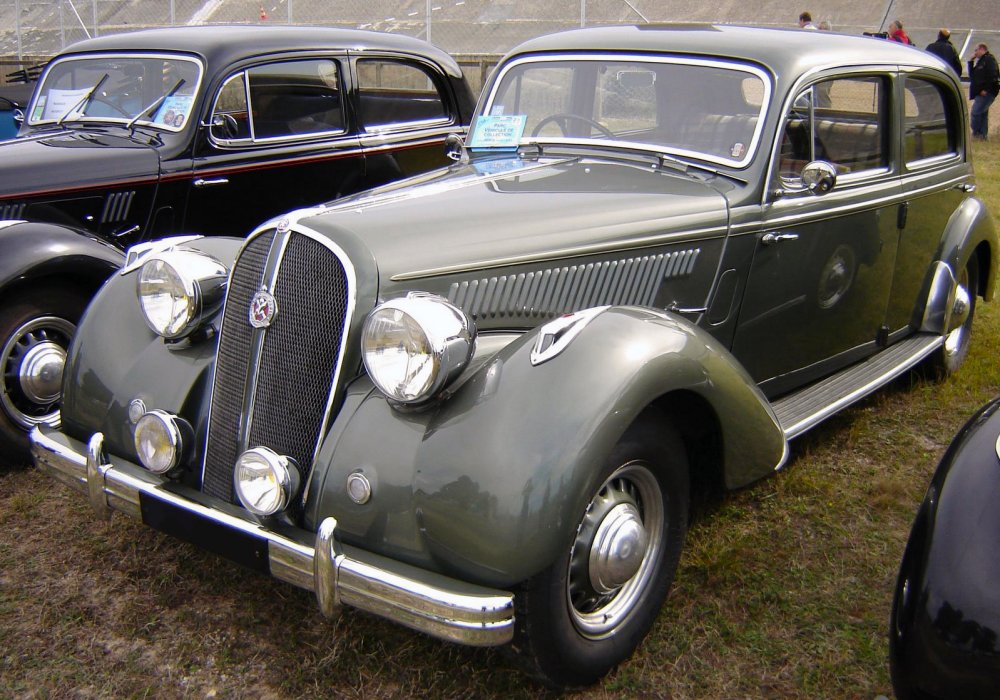
Hotchkiss 686 S49
The Hotchkiss 686 S49 was the ultimate evolution of the Hotchkiss six-cylinder line and one of the finest French grand touring cars of the immediate postwar period. Combining prewar craftsmanship with postwar refinement, it embodied the last flowering of the classic French luxury automobile before the rise of more modern, mass-produced vehicles. Introduced in 1949, the 686 S49 was a continuation of the prestigious 686 series launched in the mid-1930s, but it was updated and refined to meet the expectations of a new era of motoring while retaining the solid engineering and elegance that had long defined the Hotchkiss marque.
The heart of the 686 S49 was its 3.5-litre inline six-cylinder engine with an overhead-valve configuration, producing approximately 125 horsepower. The engine was renowned for its refinement, torque, and mechanical silence—qualities that had become synonymous with Hotchkiss. Mated to a four-speed manual gearbox, it delivered smooth acceleration and comfortable cruising at highway speeds, with a top speed of around 145 km/h (90 mph). The engine’s reliability and flexibility made it ideally suited for long-distance touring, whether on the autoroutes of France or the winding roads of the Alps.
The chassis of the 686 S49 was a masterpiece of balance and robustness. Built on a steel ladder frame, it featured independent front suspension and semi-elliptic rear leaf springs, offering excellent ride comfort and predictable handling. Hydraulic brakes were fitted on all four wheels, providing progressive and reliable stopping power. Despite its size and luxury, the car handled with confidence and composure, characteristics that helped make Hotchkiss vehicles favorites among professional drivers, government officials, and sportsmen who valued precision and dependability.
The S49’s design was a refined evolution of the prewar 686, with clean, dignified lines that carried over the restrained elegance of 1930s French styling. Its tall, vertical grille with the distinctive Hotchkiss badge gave the car a formal and commanding presence, while subtle curves along the fenders and body added grace and modernity. The overall aesthetic was conservative but beautifully proportioned, emphasizing quality over ostentation—a hallmark of the brand.
Coachbuilders played a vital role in shaping the identity of the 686 S49. Henri Chapron, one of France’s most respected ateliers, bodied many of these cars in a range of configurations including elegant four-door sedans, sporting coupés, and graceful cabriolets. Chapron’s designs for the S49 were known for their balanced proportions, impeccable craftsmanship, and subtle Art Deco influences that carried over from prewar traditions. Each car was a hand-built work of art, and no two were exactly alike.
Inside, the 686 S49 offered an environment of discreet luxury and meticulous craftsmanship. The interiors were finished with fine leather upholstery, polished wood veneers, and neatly arranged instrumentation. The dashboard was both functional and elegant, with simple gauges and solid mechanical switches that reflected the car’s high build quality. The ride was exceptionally smooth and quiet, thanks to the car’s excellent insulation and careful attention to engineering detail. Passengers enjoyed generous legroom and a level of comfort that placed the S49 among the best touring cars of its time.
On the road, the Hotchkiss 686 S49 impressed drivers with its effortless power delivery and impeccable road manners. The six-cylinder engine delivered smooth, linear acceleration and abundant low-end torque, allowing for relaxed driving even on steep gradients. The gearbox was precise, the steering well weighted, and the suspension tuned to absorb road imperfections with ease. It was a car designed for long, unhurried journeys—refined rather than aggressive, but always composed and capable.
The 686 S49 was also notable for its quality of construction. Each component was hand-fitted with the precision of a fine instrument, and the materials used were of the highest grade. This attention to detail came at a cost: the S49 was expensive, positioned alongside the finest offerings from Delahaye, Delage, and Talbot-Lago. As a result, production numbers remained small, and each example was a bespoke creation.
By the early 1950s, the 686 S49 represented the end of an era for Hotchkiss. The company, which had built its reputation on excellence and craftsmanship, soon shifted its focus toward utility and military vehicles, leaving behind the world of luxury motoring. The S49 was the final expression of its grand touring tradition—a car that combined the spirit of prewar elegance with the technical refinement of the postwar age.
Today, the Hotchkiss 686 S49 is prized by collectors as one of the last great hand-built French luxury cars. It is admired for its mechanical sophistication, timeless design, and exceptional build quality. More than just a car, it stands as a monument to the golden age of French automotive craftsmanship—a machine that captures the essence of refined power, elegance, and endurance that defined Hotchkiss at its very best.
