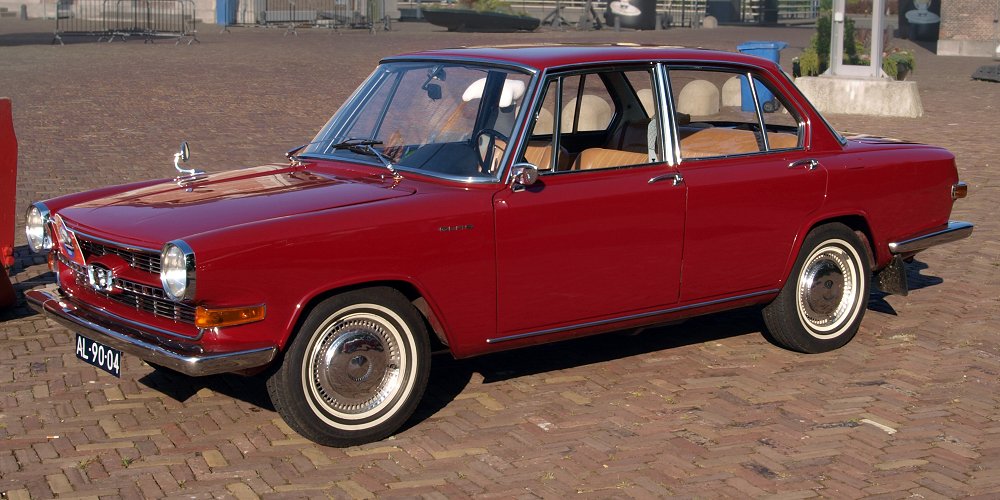
The Glas 1700 was introduced in 1964 as an evolution of the Glas 1500, offering more power, refinement, and broader appeal in the competitive mid-size family car segment. Hans Glas GmbH had already made a name for itself with innovative small cars like the 1004 and 1304, but the 1700 represented the company’s effort to challenge mainstream German sedans such as the Opel Rekord, Ford Taunus, and BMW’s Neue Klasse. With its larger engine and improved performance, the 1700 became one of Glas’s most important models of the mid-1960s.
The styling of the Glas 1700 was practical and conservative, reflecting the tastes of its era. It carried over much of the clean, angular design of the 1500, with upright proportions, simple body lines, and a horizontal front grille flanked by round headlights. Chrome trim was used sparingly to provide a sense of quality without overstatement. The car was offered in both two- and four-door saloon versions, as well as an estate (Kombi), catering to a wide range of buyers. While understated, the design conveyed solidity and maturity, helping Glas present itself as a serious competitor to the major manufacturers.
Inside, the 1700 provided a comfortable and practical cabin, clearly aimed at families and middle-class professionals. Seating was designed for four to five occupants, with more generous space than the smaller Glas cars. The interior layout was straightforward, with a full set of instruments, durable materials, and options that added a touch of comfort, such as upgraded upholstery or a radio. Though not luxurious, it struck a balance between affordability and refinement, giving buyers a well-rounded package.
The heart of the Glas 1700 was its 1,682 cc four-cylinder engine with an overhead camshaft—an advanced feature at a time when many rivals were still relying on simpler pushrod engines. Producing around 80 horsepower in standard form, the 1700 offered a top speed of about 150–155 km/h (93–96 mph), which was strong for a mid-size sedan of the mid-1960s. Power was delivered through a four-speed manual gearbox, and the engine’s OHC design ensured smoothness and efficiency, reinforcing Glas’s reputation for technical innovation.
On the road, the Glas 1700 delivered capable and comfortable performance. Its handling was predictable and secure, with light steering and a stable ride, though it was tuned more for comfort than for sportiness. For buyers who wanted more excitement, Glas introduced the 1700 TS, which featured twin carburettors and up to 100 horsepower, offering noticeably livelier performance. This broadened the appeal of the model, attracting those who wanted a family car with a touch of sporting character.
Despite its merits, the Glas 1700 faced an uphill battle in the marketplace. Competing against established giants with stronger dealer networks and better brand recognition, Glas struggled to gain significant market share. Still, the 1700 was an important model for the company, as it showed that Glas could build a mid-size car with engineering sophistication equal to, or better than, many of its rivals.
Today, the Glas 1700 is remembered as a rare but significant part of the company’s history. It represents the peak of Glas’s independent efforts in the mid-size segment before BMW acquired the firm in 1967. Surviving examples are prized by enthusiasts for their advanced engineering, understated charm, and role in demonstrating the ambitions of a small but innovative manufacturer determined to take on much larger competitors.