
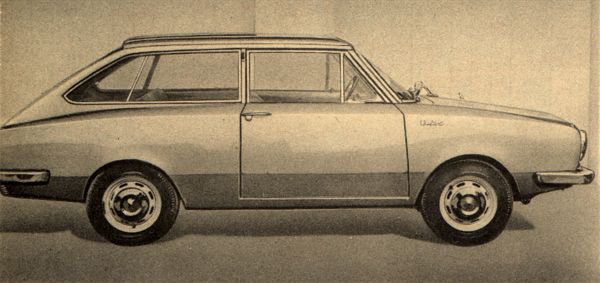
The Glas 1004 CL was one of the most notable small cars produced by Hans Glas GmbH during the 1960s, and it played a central role in establishing the company as a serious contender in the European car market. Introduced in 1962, the Glas 1004 series was groundbreaking, as it was the world’s first production car to feature an overhead camshaft (OHC) engine driven by a toothed timing belt—an innovation that would become an industry standard decades later. The 1004 CL represented the more upmarket trim level of the line, offering buyers greater comfort and refinement alongside the technical sophistication of the base car.
In terms of design, the Glas 1004 CL followed a modern, clean-cut style typical of early 1960s compact saloons. It was offered as both a two-door saloon and a coupé, with sharp, upright lines, a simple front grille, and a practical, boxy silhouette that maximized interior space. Though modest in size, the Glas 1004 looked contemporary and had a certain understated elegance, aided by restrained chrome details. The CL trim distinguished itself with higher-quality exterior finishes, including extra chrome highlights and more stylish detailing compared to the standard 1004.
Inside, the CL offered a higher standard of comfort than the base model. Upholstery was upgraded, often with better-quality fabrics or vinyl, while the dashboard featured more comprehensive instrumentation. Where the standard 1004 was plain and utilitarian, the CL added small luxury touches, such as improved trim materials and optional equipment like a radio. Seating remained arranged for four passengers, with enough space for a small family, making it a practical choice for everyday motoring.
The Glas 1004 CL was powered by the same innovative engine as the rest of the 1004 range. Its 992 cc four-cylinder engine produced around 46 horsepower, enough to give the small car a top speed of about 135 km/h (84 mph). While not a performance car, the engine’s smoothness, flexibility, and efficiency made it very well-regarded. More importantly, its pioneering OHC design set Glas apart from its competitors, as it was a major leap forward in engineering sophistication compared to the pushrod engines still common at the time. Power was delivered to the rear wheels through a four-speed manual gearbox, and the car’s light weight made it nimble and economical to drive.
On the road, the Glas 1004 CL was praised for its lively handling, smooth engine, and refined ride. It was more comfortable than earlier Glas models like the Isar, and the CL trim level made it appealing to buyers who wanted something practical but a little more prestigious. While it could not match the sales volumes of larger German rivals such as Volkswagen, the Glas 1004 carved out a loyal following among buyers who valued its engineering and individuality.
Production of the 1004 series continued until 1967, when BMW took over Glas. Some later examples were sold with BMW badging, but the car remained essentially the same. In total, the 1004 helped secure Glas’s reputation for technical innovation and showed that the small company from Dingolfing could produce cars that were both clever and competitive.
Today, the Glas 1004 CL is a rare but historically significant classic. Collectors prize it not only for its charm and compact practicality but also for its pioneering role in introducing the timing belt-driven OHC engine to the automotive world. As one of the earliest examples of Glas’s innovation, the 1004 CL stands as a milestone in engineering history, wrapped in a neat and understated small-car package.