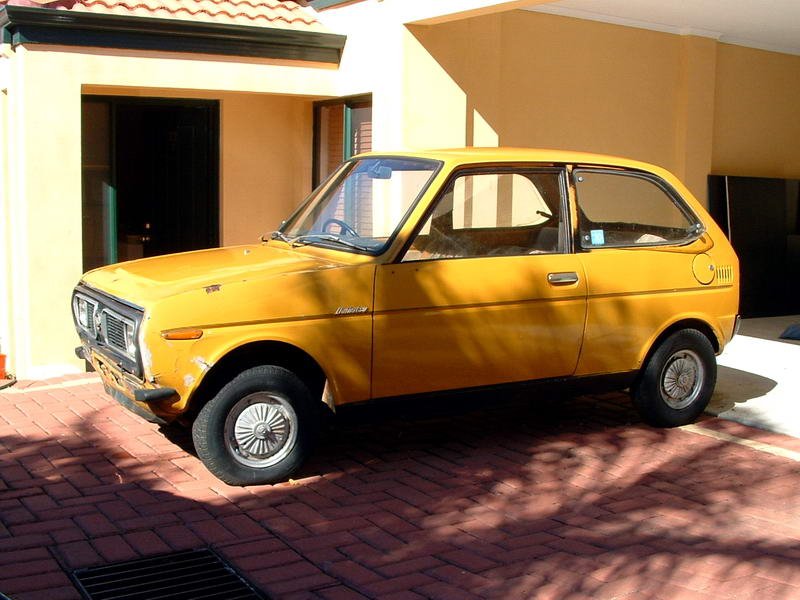
The Daihatsu Fellow Max was introduced in 1970 as the successor to the original Daihatsu Fellow series. It marked a significant step forward in the development of kei cars, both in terms of design and engineering. The Fellow Max was designed to compete more directly with popular rivals such as the Honda Life, Suzuki Fronte, and Subaru R-2, and it reflected changing consumer tastes and evolving kei car regulations.
Initially, the Fellow Max retained the 360 cc two-stroke, two-cylinder engine to comply with kei car limits of the time. This engine was mounted at the front and drove the rear wheels. In its early form, the engine produced between 28 and 33 horsepower, depending on the version. A notable variant was the Fellow Max SS, which was tuned to produce up to 40 horsepower, making it one of the sportiest kei cars of its era. These higher-output models were aimed at younger drivers who wanted more fun and performance from a very small car.
The styling of the Fellow Max was a departure from the more rounded design of earlier models. It featured a boxier, more angular shape, with larger glass areas, improved visibility, and a more modern appearance. Its compact dimensions remained in line with kei car regulations, but Daihatsu maximized interior space with a clever layout. It was offered in two-door and four-door sedan versions, as well as a van and wagon.
Inside, the Fellow Max was simple but more refined than previous kei cars. It had a proper dashboard layout, improved seating, and better sound insulation. Some versions included amenities like heater systems and even AM radios, reflecting the growing expectation for comfort and convenience even in economy cars.
In 1976, when Japan’s kei car regulations changed to allow engines up to 550 cc, Daihatsu updated the Fellow Max with a new four-stroke, water-cooled engine to meet the new rules and emission standards. This 547 cc engine delivered better fuel economy, smoother operation, and lower emissions. The upgraded versions were sometimes referred to by new internal codes but continued under the Fellow Max name until they were eventually replaced by newer models in the late 1970s.
The Daihatsu Fellow Max played a crucial role in Daihatsu’s lineup during a time of rapid growth in the kei car segment. It offered a balance of practicality, affordability, and—in certain versions—surprisingly spirited performance. Today, the Fellow Max is a lesser-known but respected name in kei car history, with surviving examples being appreciated by vintage car collectors and enthusiasts of Japanese microcars.