Description
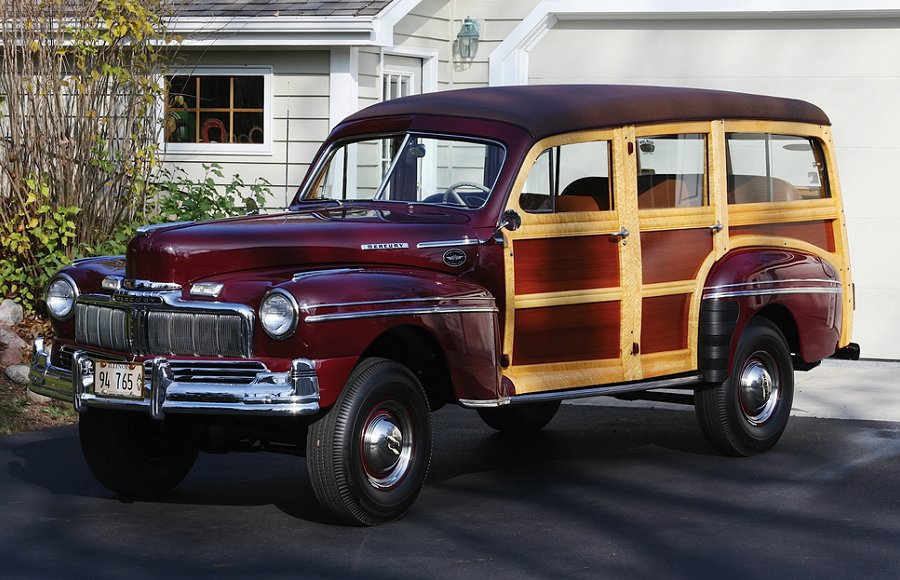
The Mercury Station Wagon Marmon-Herrington AWD was a rare and highly specialised variant of Mercury’s late-1930s and early-1940s station wagons, modified to feature four-wheel drive by the Marmon-Herrington Company. Combining Mercury’s smooth V8 power and distinctive styling with true all-wheel-drive capability, it became one of the earliest examples of a luxury-oriented American passenger vehicle equipped for serious off-road or adverse-weather use.
Marmon-Herrington was best known for converting standard Ford and Mercury vehicles into four-wheel-drive machines for military, commercial and specialist civilian applications. The conversion process retained the original Mercury chassis and body but added a transfer case, driven front axle and reinforced driveline components. The result was a capable and durable AWD system at a time when four-wheel drive was largely confined to trucks and military vehicles.
Power came from Mercury’s flathead V8 engine, typically the 239 cubic inch unit. This engine was valued for its smooth torque delivery and reliability rather than outright performance. In the Marmon-Herrington conversion, the V8’s strong low-speed pulling power complemented the added traction of four-wheel drive, making the wagon especially capable on unpaved roads, snow-covered terrain or rural routes. A manual transmission was standard, working in conjunction with the transfer case to distribute power to both axles.
The station wagon body style was particularly suited to the AWD conversion. Mercury’s wagons of the period featured a combination of steel structure and wood-bodied panels, creating the classic “woodie” appearance that defined American wagons of the era. Spacious and practical, the wagon offered seating for multiple passengers along with substantial cargo capacity. With the Marmon-Herrington drivetrain, this practicality was extended to areas and climates where standard rear-wheel-drive vehicles might struggle.
Suspension was modified to accommodate the driven front axle, often raising ride height slightly and reinforcing key components. While handling was more utilitarian than refined, the vehicle gained significantly improved traction and stability in difficult conditions. This made it attractive to rural professionals, estate owners, utility companies and even government services requiring passenger capacity combined with off-road ability.
Inside, the Mercury Station Wagon Marmon-Herrington AWD retained the comfort and refinement expected of the Mercury brand. Upholstery and trim were superior to Ford equivalents, and the driving position was spacious and upright. The interior balanced practicality with a level of style that set it apart from more utilitarian four-wheel-drive trucks of the time.
Production numbers were extremely limited, as Marmon-Herrington conversions were carried out to order rather than mass produced. This rarity, combined with the fragile nature of wood-bodied station wagons, means that surviving examples are exceptionally scarce today.
The Mercury Station Wagon Marmon-Herrington AWD occupies a unique place in automotive history. It represents one of the earliest attempts to combine passenger car comfort with genuine four-wheel-drive capability, decades before all-wheel drive became common in family vehicles. As a classic, it stands as a fascinating example of pre-war innovation, blending American V8 smoothness, handcrafted wagon styling and specialist drivetrain engineering into a vehicle that was far ahead of its time.