The Mercedes-Benz F 100 was an advanced experimental vehicle unveiled in 1991 and represented one of the most comprehensive explorations of future vehicle technology ever undertaken by Mercedes-Benz. Rather than focusing on a single innovation, the F 100 was conceived as a rolling research laboratory that brought together new ideas in safety, driver assistance, human–machine interaction and vehicle electronics, many of which would not reach production for decades.
The F 100 was based loosely on the proportions of a large luxury saloon, broadly comparable in size to an S-Class, but its purpose was entirely experimental. The exterior design was clean and restrained, deliberately avoiding extreme styling so that attention remained on the technology rather than visual drama. Aerodynamics, visibility and packaging were all carefully considered, reinforcing the idea that the F 100 was intended as a realistic vision of the near future rather than a fantasy concept.
One of the most significant aspects of the Mercedes-Benz F 100 was its focus on driver assistance systems. It featured early versions of technologies that would later become central to modern vehicles, including adaptive cruise control using radar, distance warning systems and collision avoidance concepts. These systems were designed not to replace the driver, but to support them by reducing workload and helping prevent accidents, reflecting Mercedes-Benz’s long-standing philosophy that safety should be active as well as passive.
The F 100 also explored new approaches to vehicle control and human–machine interaction. Traditional mechanical linkages were replaced or supplemented by electronic systems, including early drive-by-wire and steer-by-wire concepts. Steering input, braking and throttle control were electronically mediated, allowing engineers to study how vehicles could be controlled more precisely and safely using redundant electronic systems. These ideas laid the groundwork for later developments in electronic stability control, brake assist and advanced chassis management.
Interior design was another key area of experimentation. The cabin of the F 100 was dominated by digital displays and multifunction controls, replacing many conventional switches and gauges. Information was presented in a clear, prioritised manner to reduce driver distraction, an idea that would later influence modern digital instrument clusters and head-up displays. Voice control and touch-sensitive interfaces were also explored, long before such systems became commonplace.
Safety technology extended beyond electronics. The F 100 incorporated advanced structural concepts, improved crumple zones and innovative restraint systems. Airbags, seat belt technologies and interior energy-absorbing structures were studied as part of a holistic safety approach, reinforcing Mercedes-Benz’s belief that accident prevention and crash protection must work together.
Powertrain technology was not the primary focus of the F 100, but efficiency and refinement remained important. The vehicle used a conventional internal combustion engine as a test platform, allowing engineers to concentrate on electronic systems without introducing unnecessary variables. This decision underlined the project’s emphasis on systems integration rather than propulsion experimentation.
The Mercedes-Benz F 100 was never intended for production, but its influence on future vehicles was profound. Many of the concepts first demonstrated in the F 100 gradually appeared in production Mercedes-Benz models throughout the 1990s and 2000s. Adaptive cruise control, radar-based driver assistance, electronic braking systems, digital dashboards and advanced safety electronics can all trace part of their development lineage back to this project.
In hindsight, the F 100 can be seen as remarkably forward-thinking. At a time when most cars still relied heavily on mechanical systems and analogue interfaces, Mercedes-Benz was already envisioning a future dominated by software, sensors and intelligent assistance. The project demonstrated not only technical capability, but also a clear philosophy about the direction of automotive development.
Today, the Mercedes-Benz F 100 is regarded as a landmark concept in the history of automotive technology. Its significance lies not in styling or performance figures, but in how accurately it predicted the trajectory of modern vehicle design. As a historical research vehicle, the F 100 stands as evidence of Mercedes-Benz’s methodical, long-term approach to innovation, showing how ideas explored in experimental form can quietly shape the everyday cars of the future.
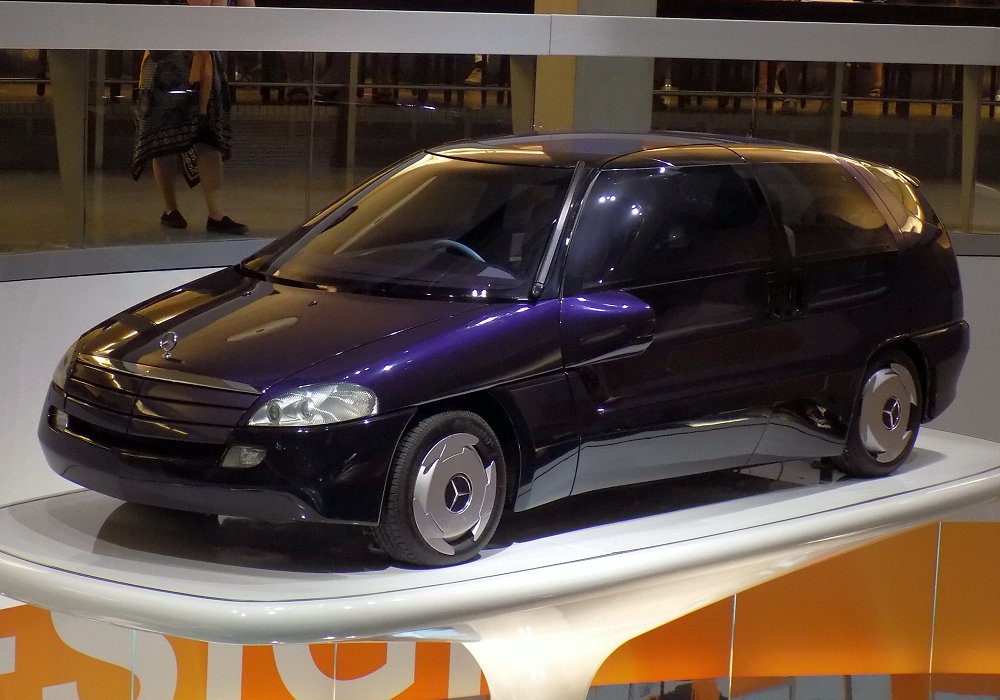
Mercedes-Benz F 100
| Vehicle | Manufacturer | Mercedes Benz |
|---|---|
| Country | Germany |
| Production Started | 1991 |
| Production Stopped | 1991 |
| Production Numbers | |
| Vehicle Type | |
| Bodystyle | MPV |
| Number of Doors | 5 |
| Number of Seats | 5 |
| Engine | Engine Manufacturer | Mercedes Benz |
|---|---|
| Engine | V6 |
| Engine Location | Front |
| Engine Displacement | 2600 cc |
| Valvetrain | DOHC |
| Valves per Cylinder | 4 |
| Bore | mm |
| Stroke | mm |
| Compression Ratio | |
| Cooling System | Water |
| Charging System | |
| Fuel Type | Petrol |
| Fuel System | Injection |
| Fuel Capacity | |
| Aspiration | Normal |
| Performance | Top Speed | 124 mph |
|---|---|
| Acceleration | s |
| Power | |
| Torque | 250 / 184 |
| Steering, Transmission & Suspension | |
|---|---|
| Drivetrain | Front |
| Transmission | A3 |
| Steering | |
| Front Suspension | |
| Rear Suspension | |
| Front Brakes | |
| Rear Brakes | |
| Chassis | |
| Tyre Dimensions |
| Dimensions | |
|---|---|
| Weight | 1450 kg |
| Length | 4830 mm |
| Width | 1785 mm |
| Height | 1530 mm |
| Wheelbase | 2950 mm |