Description
The Hotchkiss Willys Jeep JH 101 13 CV was one of the earliest French-produced Jeeps built under license from Willys-Overland in the early 1950s, marking the beginning of Hotchkiss’s transformation from a maker of fine prewar luxury cars into a producer of rugged, military and utility vehicles. The JH 101 was effectively the French-built continuation of the legendary Willys Jeep, adapted for postwar civilian and military use in France. It embodied the same reliability and toughness that had made the wartime Jeep an icon, while reflecting the precision manufacturing standards for which Hotchkiss was known.
After World War II, the French Army and civilian sectors relied heavily on surplus American Jeeps left behind by Allied forces. By the early 1950s, however, these vehicles were aging and difficult to maintain. To ensure a steady supply of parts and vehicles, Hotchkiss et Cie obtained the rights to build the Willys Jeep in France. The first production models, assembled mostly from imported American components, carried the designation Hotchkiss Willys JH 101—where “JH” stood for “Jeep Hotchkiss.”
The JH 101 was powered by the same robust four-cylinder “Go-Devil” engine used in the original Willys MB. This 2.2-litre side-valve unit produced approximately 60 horsepower and was paired with a three-speed manual gearbox and a two-speed transfer case, giving the Jeep its famous four-wheel-drive capability. This combination provided excellent torque at low speeds, enabling the vehicle to tackle steep inclines, mud, and rough terrain with ease. The engine’s reliability and simplicity made it easy to maintain and repair even under difficult conditions, a vital trait for postwar Europe where spare parts and skilled mechanics were often scarce.
The chassis and suspension were faithful to the wartime Willys MB design. The steel ladder-frame chassis provided strength and rigidity, while solid axles and semi-elliptic leaf springs front and rear gave the JH 101 its unmistakable ruggedness. The vehicle’s compact dimensions, short wheelbase, and generous ground clearance made it exceptionally maneuverable off-road. Hydraulic drum brakes and a part-time four-wheel-drive system added to its dependable all-terrain performance.
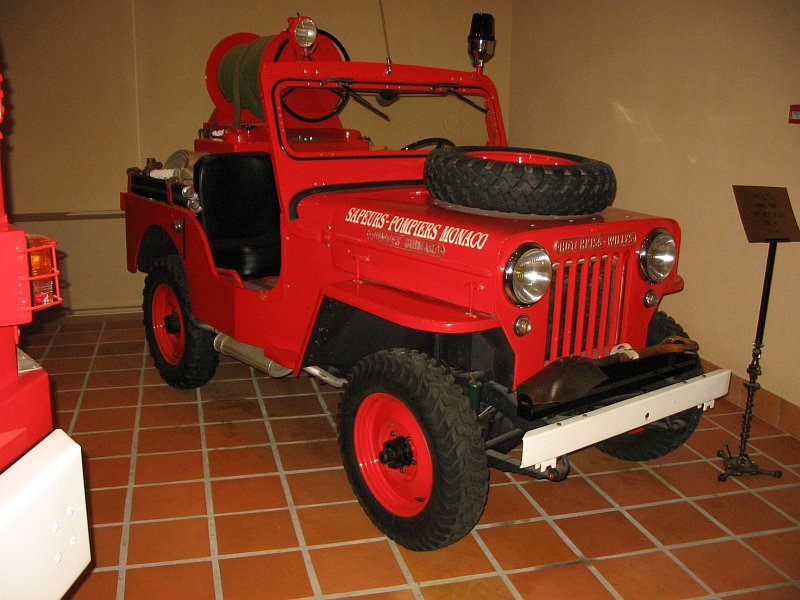
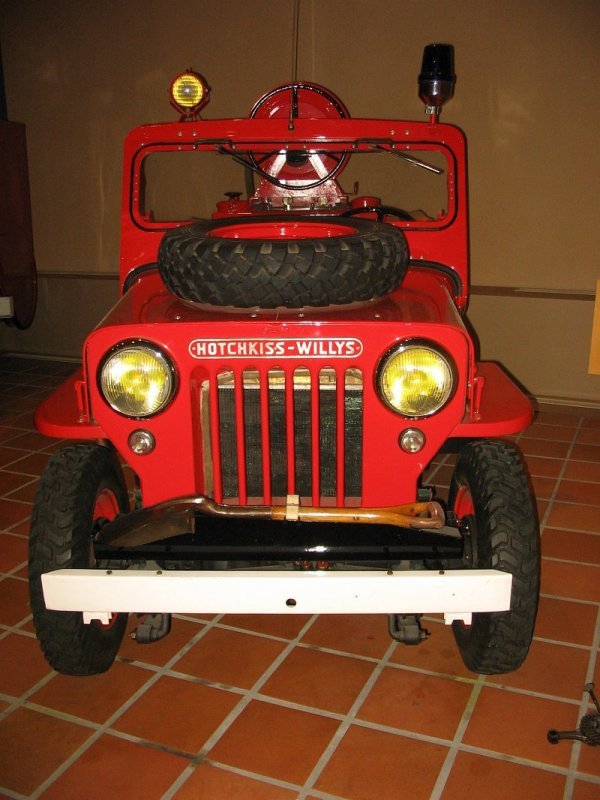
Visually, the JH 101 was nearly identical to the wartime Jeep. It featured the flat, upright grille with vertical slots, round headlights, and a fold-down windshield. The open body design, with removable canvas doors and roof, made it versatile for both civilian and military use. It could be fitted with various accessories, including a rear-mounted spare wheel, shovel and axe mounts, and optional lighting and radio equipment. Its utilitarian appearance was part of its charm—function dictated form entirely, resulting in one of the most recognizable silhouettes in automotive history.
Hotchkiss manufactured the JH 101 primarily at its Saint-Denis plant near Paris. The model’s “13 CV” designation referred to its French fiscal horsepower rating, placing it in the mid-range category for taxation purposes. Early production relied heavily on American components supplied by Willys, but as production continued, Hotchkiss gradually localized manufacturing, producing more parts domestically until the vehicle became effectively a French-built Jeep.
The JH 101 was used widely by both civilian organizations and the French military. In military service, it served as a stopgap between wartime Jeeps and the later, fully French-built M201 that would go on to serve for decades. Civilian versions were also produced for agricultural, industrial, and commercial applications, where their reliability and off-road ability proved invaluable in France’s rural and mountainous regions.
Although the JH 101 was short-lived in production—built mainly between 1950 and 1952—it was a crucial transitional model. It bridged the gap between the imported wartime Jeeps and the domestically produced Hotchkiss M201 that followed. It allowed French engineers and suppliers to gain the experience needed for full-scale production while continuing to meet the country’s immediate demand for light utility vehicles.
Today, the Hotchkiss Willys Jeep JH 101 13 CV is a rare and historically important vehicle among Jeep enthusiasts and military collectors. It represents a fascinating intersection between American design and French craftsmanship—a faithful continuation of the Jeep legacy, built with the precision and care of one of France’s oldest engineering firms. Surviving examples are prized for their authenticity and mechanical honesty, often restored to their original olive-drab military or simple civilian finishes.
The JH 101’s legacy lies in its role as the foundation for all subsequent French Jeep production. It symbolized a nation rebuilding itself after war, using proven technology to create new industries and strengthen its independence. More than just a copy of an American design, the Hotchkiss Willys JH 101 13 CV was the beginning of a uniquely French Jeep story—one that would continue successfully for more than three decades.