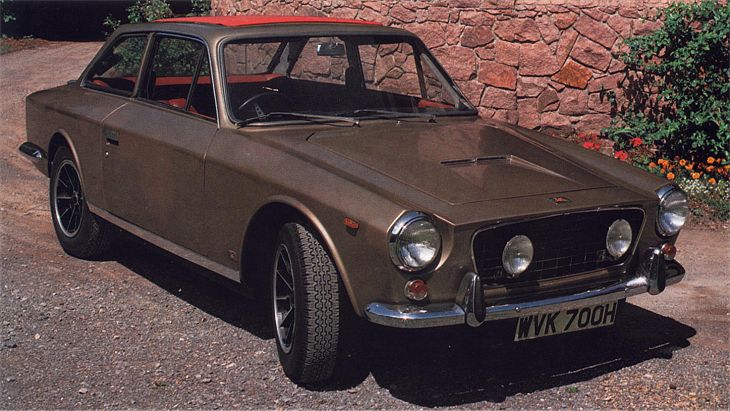
The Gilbern Invader was the last and most developed model produced by Gilbern, a small but ambitious Welsh car manufacturer that operated from the late 1950s through the 1970s. Introduced in 1969 as the successor to the Genie, the Invader was a stylish, hand-built sports coupé that combined British craftsmanship with powerful Ford-sourced engines. It represented Gilbern’s attempt to step up into a more refined and luxurious market segment while still offering the performance and individuality that had attracted enthusiasts to the brand.
The exterior design of the Invader was sleek and contemporary for its era. It was a two-door fastback coupé with clean, flowing lines, a long bonnet, and a sharply cut rear end. The body was made of glassfibre, which allowed Gilbern to keep production costs lower while giving the car a distinctive, lightweight structure. Details like chrome bumpers, slim pillars, and a wide grille lent it a modern, upscale look that stood out from mainstream British cars of the period.
Inside, the Invader was well-appointed for a low-volume hand-built car. The cabin featured comfortable seating for four, with leather upholstery, wood veneer trim, and a comprehensive dashboard filled with gauges. Compared to earlier Gilberns, the Invader’s interior was more polished and aimed at competing with established marques like Jaguar, TVR, and Lotus. Despite being produced by a small company, it offered buyers the kind of refinement they might expect in higher-end sports tourers.
Mechanically, the Gilbern Invader was based on proven Ford components, ensuring reliability and performance. Early versions were powered by Ford’s 3.0-litre Essex V6 engine, delivering around 140 horsepower, while later models could be equipped with Ford’s 3.0-litre V6 or even larger V8 engines in special builds. Power was sent to the rear wheels through a four-speed manual gearbox, with overdrive available. Suspension came from Ford’s mid-size saloons, but Gilbern reworked the setup for sharper handling. Disc brakes at the front and drums at the rear were standard, with later upgrades to all-disc braking on higher-spec versions.
Over its production run, the Invader went through three distinct series: the Mk I (1969–1971), Mk II (1971–1972), and Mk III (1972–1974). Each iteration brought improvements, such as wider tracks, upgraded suspension, and more luxurious interiors. The Mk III, in particular, is considered the most refined, with flared wheel arches, revised styling, and improved equipment levels.
On the road, the Invader offered strong performance for its time. The combination of a relatively lightweight glassfibre body and Ford’s torquey V6 engine gave it lively acceleration, while its well-tuned suspension provided enjoyable handling. It was less of a raw sports car than a grand tourer, aimed at buyers who wanted both speed and comfort.
Production numbers were always limited, as Gilbern was a small operation with modest resources. Around 600 Invaders were built in total before the company ceased production in 1974 due to financial difficulties and the challenges facing small-scale carmakers in an era of stricter regulations and rising costs.
Today, the Gilbern Invader is celebrated as a rare and distinctive British classic. Its combination of stylish design, Ford mechanicals, and Welsh heritage makes it an unusual but appealing collector’s car. Enthusiasts value it for its blend of performance and individuality, as well as its status as one of the very few production cars ever built in Wales. Surviving examples are cherished for their rarity and charm, standing as a reminder of a bold but short-lived chapter in Britain’s motoring history.