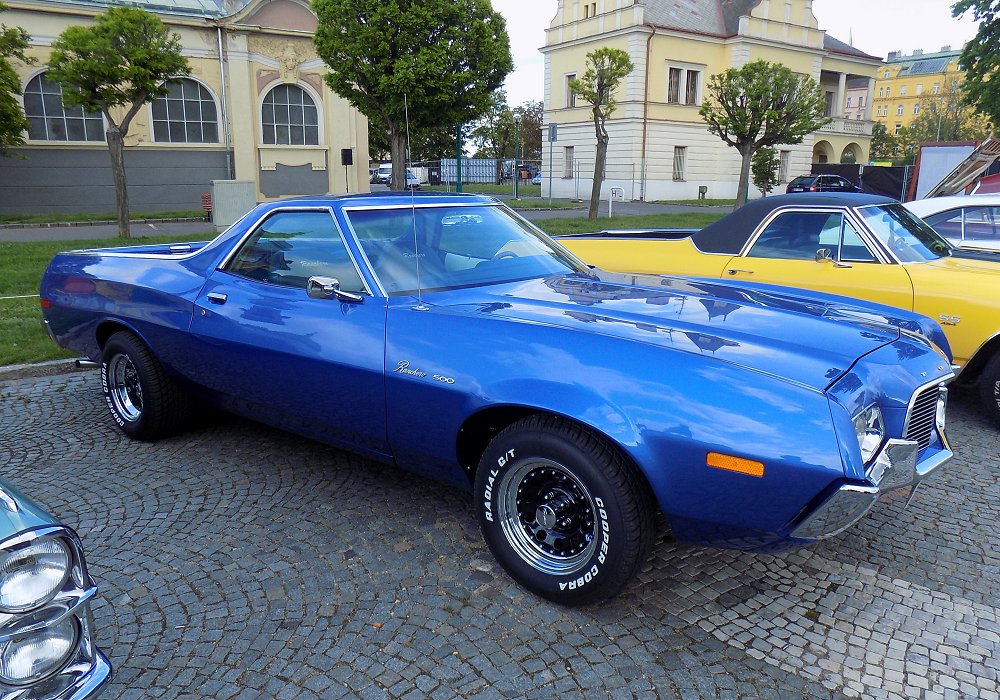
Ford Ranchero 500
The Ford Ranchero 500 was one of the mid-level trims offered on Ford’s car-based pickup line during the late 1960s and early 1970s. The Ranchero itself, first introduced in 1957, was a unique concept for the American market, combining the comfort and styling of a passenger car with the practicality of a light-duty pickup. By the time the Ranchero 500 appeared, Ford had refined the model into a versatile vehicle that appealed to both working drivers and buyers who wanted something stylish and unconventional.
From the outside, the Ranchero 500 reflected the styling of the car platform it was based on, most commonly the Fairlane or Torino, depending on the year. This meant that the 500 carried many of the same design cues as Ford’s mid-size cars: long hoods, sweeping body lines, and chrome trim. The 500 trim positioned it above the base Ranchero, so it typically included extra brightwork, upgraded wheel covers, and badging that emphasized its more upscale nature. Its proportions gave it a distinctive look, with the front half appearing like a coupe or sedan and the rear blending seamlessly into the integrated pickup bed.
Inside, the Ranchero 500 offered a level of comfort and convenience that set it apart from traditional work trucks of the time. A wide bench seat was standard, but the 500 trim featured better-quality upholstery in vinyl or cloth-and-vinyl combinations compared to the plainer base models. The dashboard layout was borrowed directly from Ford’s mid-size cars, meaning it had a more refined appearance than most pickups of its day. Options such as air conditioning, power steering, radios, and upgraded instrumentation allowed buyers to tailor their Ranchero to either work or leisure use.
Under the hood, the Ranchero 500 could be equipped with a wide variety of engines, depending on the year and buyer’s preference. Base models often carried a six-cylinder engine for economy, but most 500s were ordered with small-block V8s like the 289, 302, or 351 cubic inch engines. For those wanting more performance, larger FE-series V8s such as the 390 or even big-blocks like the 428 and 429 were available in later years, giving the Ranchero muscle car levels of power in a utility body style. Transmissions ranged from three-speed manuals to four-speeds and Ford’s Cruise-O-Matic automatic.
On the road, the Ranchero 500 drove much like the mid-size cars it was based on. Its suspension tuning gave it a smoother, more comfortable ride than body-on-frame trucks, making it well-suited for daily use. At the same time, the pickup bed provided a level of practicality that appealed to buyers who needed to haul light loads, tools, or recreational gear. With V8 power, the Ranchero 500 could accelerate confidently and even tow modest trailers, giving it real versatility.
The Ranchero 500 was priced as a step above the entry-level models but below the more luxurious or performance-oriented GT versions. It was aimed at buyers who wanted something practical yet stylish, bridging the gap between a work vehicle and a personal car. Its appeal was particularly strong among younger drivers and suburban buyers who didn’t need a full-sized truck but appreciated the Ranchero’s distinctive character.
Today, the Ford Ranchero 500 is appreciated as a unique classic that reflects a fascinating chapter in Ford’s history. While overshadowed in collector circles by the rarer GT and high-performance versions, the 500 remains a desirable choice for enthusiasts who enjoy its blend of style, comfort, and practicality. Surviving examples showcase the versatility of the Ranchero concept and highlight why this car-truck hybrid has remained an enduring icon of mid-century American motoring.
