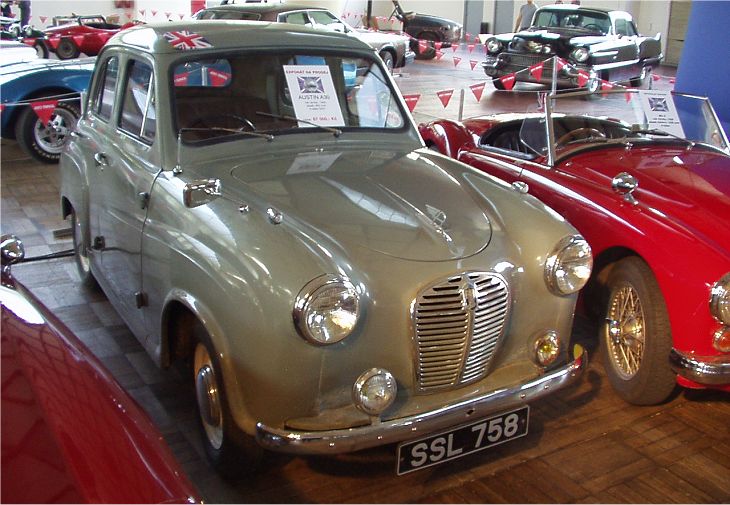
Austin A30 Seven 4D
The Austin A30 Seven 4D was the four-door variant of the Austin A30, a small and economical family car produced between 1951 and 1956. Designed to provide affordable and practical motoring, it was one of the first British cars to feature a monocoque construction, making it lighter and more rigid than earlier models.
Powered by an 803cc A-Series four-cylinder engine, the A30 4D produced around 28 horsepower. While modest in output, the engine provided adequate performance for everyday driving, reaching a top speed of approximately 65 mph. The four-speed manual gearbox allowed for smooth operation and good fuel efficiency, making it a cost-effective choice for families and budget-conscious motorists.
The styling of the A30 was rounded and compact, featuring a prominent front grille and separate headlights. The four-door version offered improved accessibility for passengers, making it a more practical option for families compared to the two-door model. Inside, the cabin was simple but functional, with seating for four passengers, a basic dashboard layout, and essential instrumentation.
The A30 was well-regarded for its durability and ease of maintenance, qualities that made it popular among first-time car owners. Its compact size made it easy to maneuver in city traffic while still offering reasonable interior space for a small car. The successor, the Austin A35, introduced refinements but retained the core characteristics that made the A30 successful.
Today, the Austin A30 Seven 4D remains a beloved classic, valued by enthusiasts for its charming design, historical importance, and connection to post-war British motoring. Well-preserved examples are frequently seen at vintage car shows, where they continue to be appreciated for their simplicity and character.
